
Short-Form Paid Adverts
Turn long-form content into ad-ready video assets with clearer hooks, faster testing, and better reuse.
One strong long-form asset can become a stream of short paid adverts when the right moments are extracted, structured, and packaged for performance.
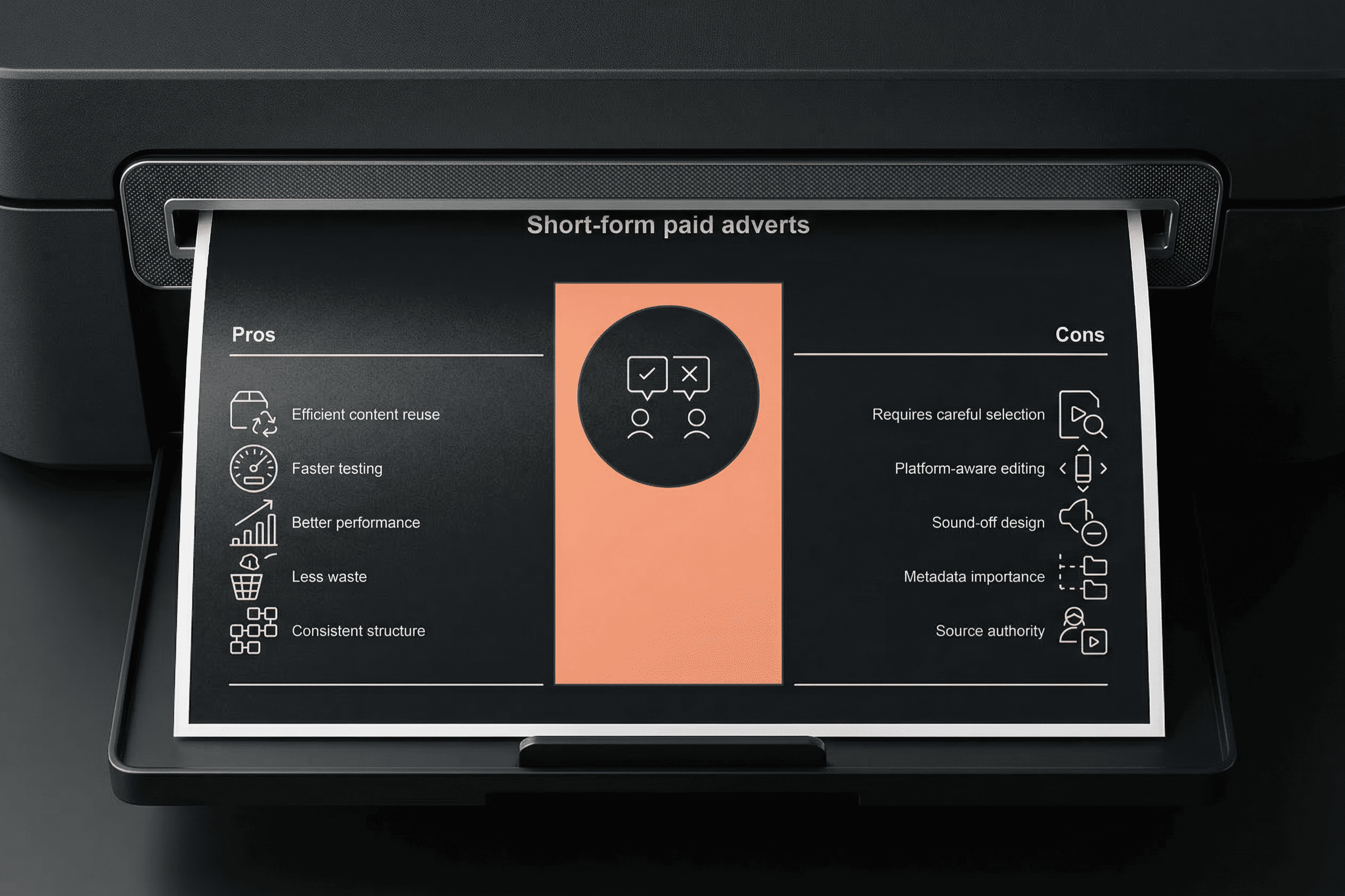
Short-form paid adverts
Pros
Efficient content reuse
Faster testing
Better performance
Less waste
Consistent structure
Cons
Requires careful selection
Platform-aware editing
Sound-off design
Metadata importance
Source authority
From long-form source to paid-ready clips.
A more efficient route from full-length content to advert creative.
Short paid adverts perform better when they begin with material that already contains substance. Instead of inventing every creative asset from nothing, use long-form content as the source and extract the moments most likely to stop attention, communicate value, and move viewers toward action.
Built around high-value moments
The workflow starts by identifying moments with a clear hook, a single useful idea, and a strong payoff. These moments are easier to cut into short advert formats because the value is already present in the source.
Less creative waste
Rather than making separate adverts for every campaign concept, the same long-form asset can generate multiple short versions with different hooks, titles, captions, and calls to action.
More testing without more overhead
One source video or article can feed several variants. That gives smaller teams a practical way to test creative angles, audiences, and platform formats without multiplying production time in the same proportion.

Efficient Ad Creative Generation
Identify High-Value Moments - Extract hooks, ideas, payoffs
Create Short Ad Variants - Generate multiple versions with different hooks
Test Creative Angles - Evaluate variants for performance
Extract the moments that can carry the advert.
Strong short adverts begin with precise selection, not random clipping.
The most useful clips are the ones that answer one thing quickly, demonstrate one clear point, or create immediate curiosity in the first few seconds.
Hook-led moments
Look for provocative statements, strong claims, question-led openings, or surprising statistics that can work as a stopping point inside the first few seconds.
Action-led moments
How-to steps, short demonstrations, and before-and-after explanations often make stronger advert material because the value is more obvious.
Evidence-led moments
If the clip contains proof, outcomes, or a concrete example, it becomes easier to trust and easier to test as paid creative.
Build short advert scripts from proven source material.
A compact structure makes short videos easier to test and easier to scale.
Level Three and Level Four extend BAG beyond article drafting alone. They support earlier-stage ideation and later-stage output handling, helping the workflow stay more connected from planning through to usable article files.

Advert Script Development Process
Source Material > Hook > Value > Proof > CTA > Actionable Advert
Use a four-part advert structure.
A short paid advert becomes easier to make and easier to compare when the structure stays consistent.
Hook - Open with a problem, question, or friction point inside the first few seconds.
Value - State the main solution, insight, or takeaway in one clear line.
Proof - Show a quick example, a result, or a simple demonstration that makes the claim more believable.
CTA - Close with one action only: read more, watch more, click through, sign up, or learn the process.

Paid Ad Editing Tips
Vertical-First Viewing - Use 9:16 framing, keep the focal point central, and ensure important visual elements are visible on smaller screens.
Sound-Off Behaviour - Captions are essential as many viewers will see the advert without sound first. The text layer must clearly convey the message.
Purposeful On-Screen Text - Highlight the most important phrase, stat, or action rather than filling the frame with too much copy.
Short paid adverts need platform-aware formatting.
Each clip should be edited for how people actually watch.
Paid performance depends on how quickly the advert can communicate value in the feed.
Edit for vertical-first viewing
Use 9:16 framing where the platform expects it, keep the focal point central, and make sure the important visual elements stay visible on smaller screens.
Design for sound-off behaviour
Captions are not optional. Many viewers will see the advert without sound first, so the text layer has to carry the message clearly.
Keep on-screen text purposeful
Highlight the most important phrase, stat, or action rather than filling the frame with too much copy.
Metadata improves discoverability and reuse.
Paid adverts perform better when the surrounding signals are also organised.
The advert itself matters, but so does the information around it.
Create title variants.
A single short video can support multiple paid angles when paired with different title treatments or thumbnail messages.
Publish transcripts and descriptions.
Short descriptions, visible transcripts, and section-level context help the asset remain useful not only in paid campaigns but also in search, AEO, and embedded page environments.
Use structured video markup.
Where the advert is hosted on-site, VideoObject schema and video sitemap entries can support indexing, page-level visibility, and stronger content organisation.
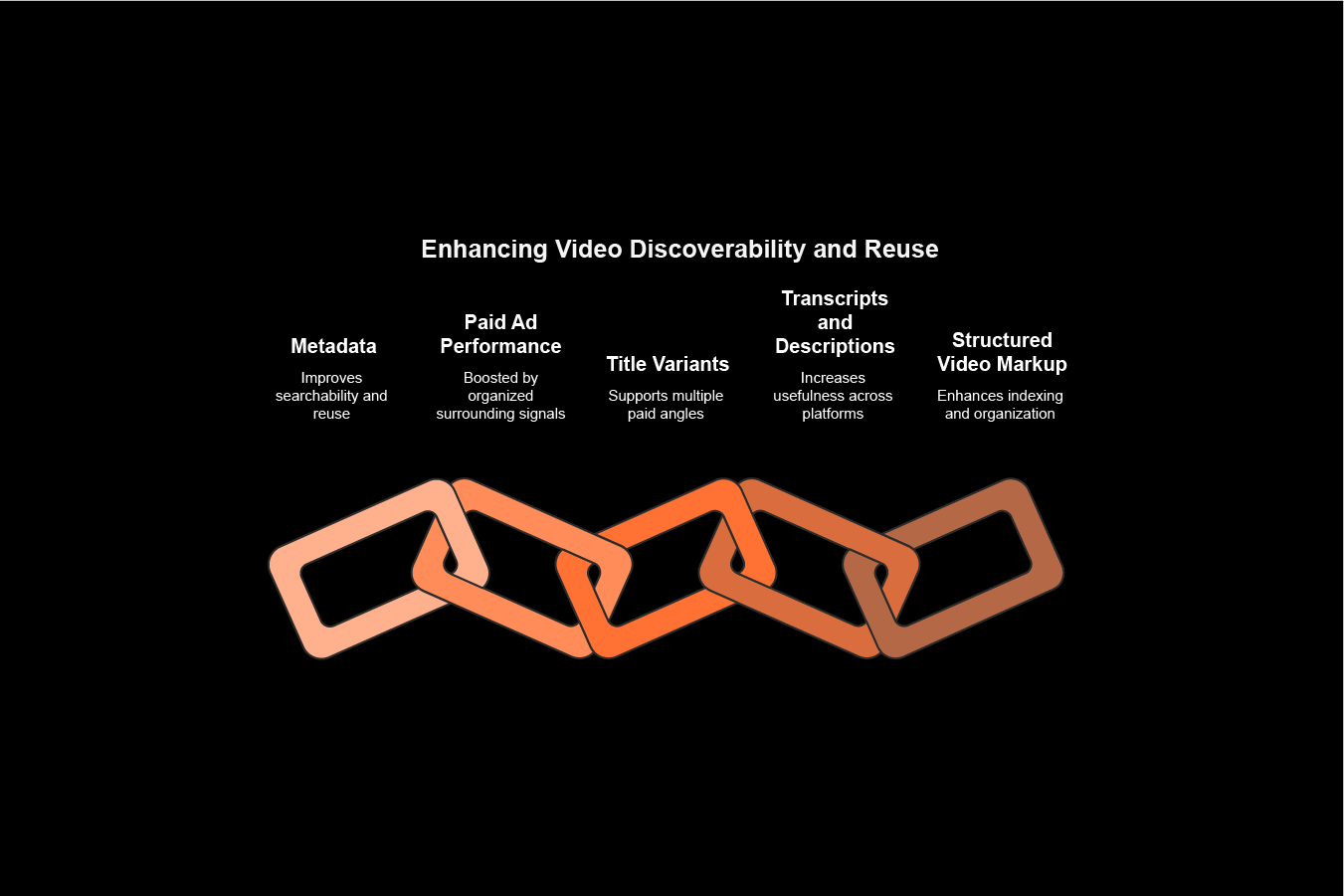
Enhancing Video Discoverability and Reuse
Metadata - Improves searchability and reuse
Paid Ad Performance - Boosted by organised surrounding signals
Title Variants - Supports multiple paid angles
Transcripts and Descriptions - Increases usefulness across platforms
Structured Video Markup - Enhances indexing and organisation

Supporting Signals for Promoted Content
Multiple Heading Angles - Prepare alternate titles and message frames to test different campaign objectives.
Readable Context - Add descriptions, transcripts, and supporting copy to extend the usefulness of the advert.
Video Markup - Use structured data and sitemap support to help search systems understand the video content.

Optimising Paid Media Reach
Technical Markup - Using structured data to improve search engine interpretation.
Organised Metadata - Structured data that enhances ad visibility and testing.
Text-Based Context - Providing supporting text to enhance asset value.
Alternative Message Wrappers - Adapting content for diverse paid approaches.
Use the source asset as the authority layer.
The short advert should point back to a stronger canonical destination.
A paid short video works best when it is not treated as an isolated asset. It should connect back to a fuller destination where the viewer can continue the journey.
Link to the source article or landing page.
The advert should send traffic to the most relevant canonical page, not to a disconnected destination that breaks the context.
Maintain timestamps and source IDs.
Keeping source references attached to every short makes it easier to review claims, refresh content, and create new variants later without repeating the full extraction process.
Reuse without losing traceability.
When creative teams can trace every short back to a longer source asset, the workflow becomes easier to scale and easier to govern.
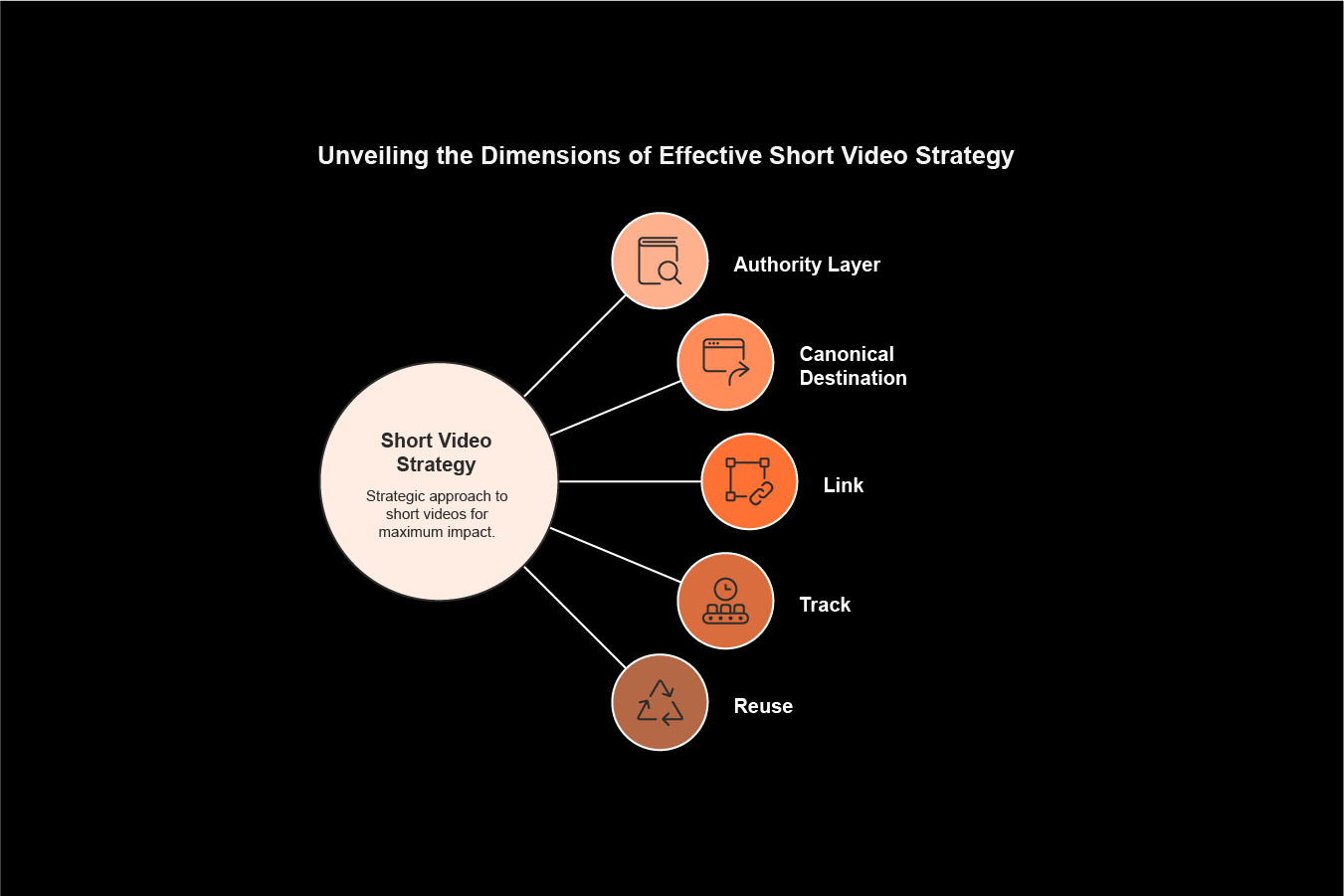
Unveiling the Dimensions of Effective Short Video Strategy
Short Video Strategy - Strategic approach to short videos for maximum impact.
Authority Layer
Canonical Destination
Link
Track
Reuse
Automation should remove repetitive work, not editorial control.
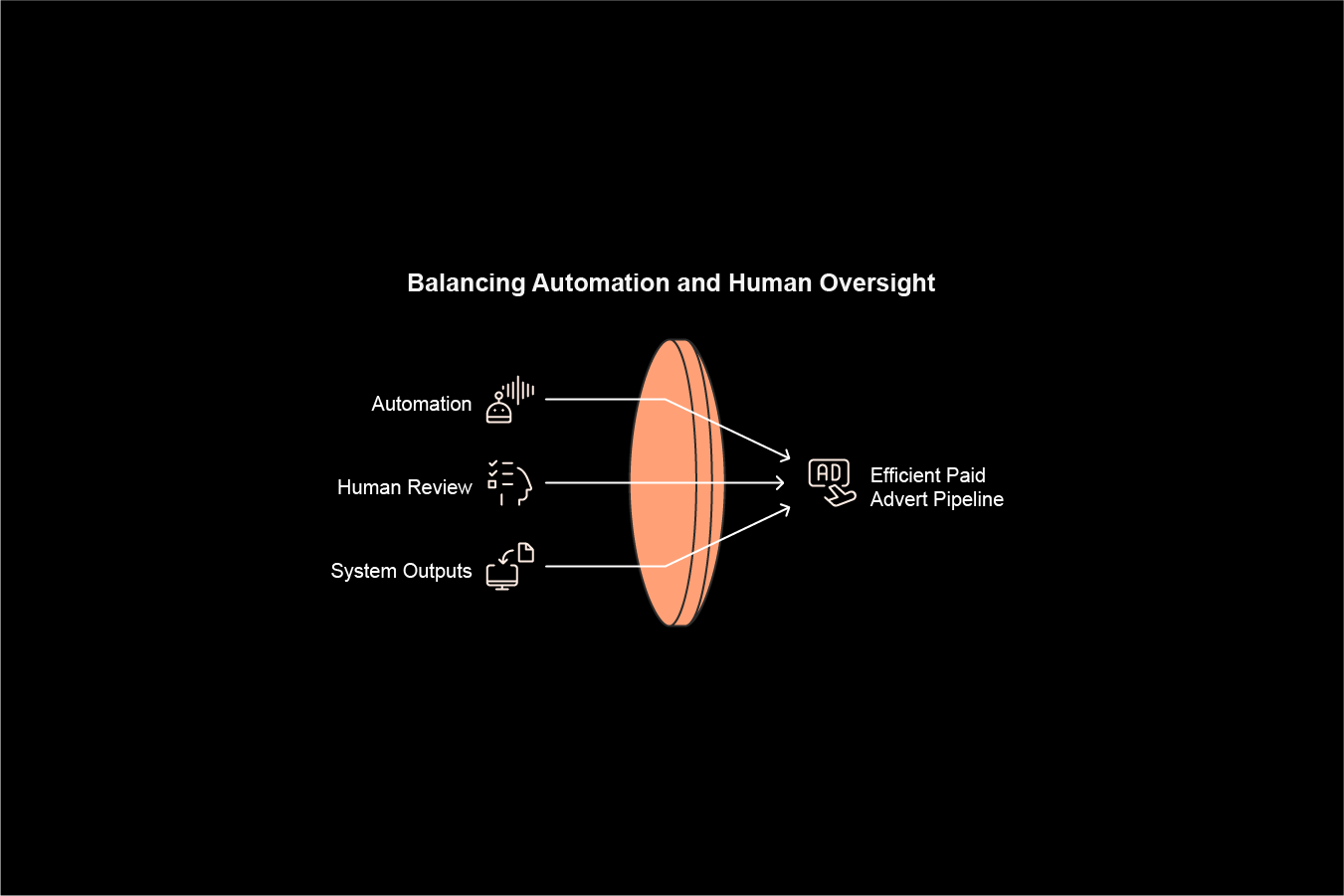
Balancing Automation and Human Oversight
Automation
Human Review
System Outputs
Efficient Paid Advert Pipeline
Use AI and automation where they reduce delay, not where they weaken quality.
There are several parts of the paid advert pipeline that benefit from automation.
Useful automation points - Batch transcription, caption generation, vertical cropping, initial title variants, thumbnail drafts, and scene detection can all save significant time.
Useful human review points - Fact checking, tone checks, timing refinement, and final call-to-action alignment should still be reviewed manually before launch.
Useful system outputs - A good workflow should store prompts, timestamps, metadata, transcript files, tags, and performance labels so the next round of advert creation becomes easier.
Paid campaigns should learn from organic performance.

Key Strategies for Paid Campaign Optimisation
1. Leverage Organic Insights - Identify top-performing organic content for paid campaign inspiration.
2. Utilise Engagement Signals - Use scroll depth and retention spikes to select creative assets.
3. Iterative Feedback Loop - Feed paid campaign performance back into organic content creation.
The strongest advert angles often come from what already held attention elsewhere.
Long-form articles, webinars, podcasts, and full-length videos often reveal the moments that deserve paid budget.
Use engagement signals to pick creative.
Scroll depth, retention spikes, replay segments, and time-on-page patterns can all help identify the clips most likely to perform as adverts.
Feed performance back into the system.
When one short advert outperforms the others, store that hook, title pattern, and structure as a model for future creative production.
Let paid and organic improve each other.
Short paid adverts can test hooks and messaging quickly, then those winning ideas can be applied back into landing pages, long-form content, and SEO-led structures.
Why this matters now.
Paid adverts perform better when they come from stronger source material.
In 2026, paid media is no longer only about buying reach. It is also about using creative systems that can respond faster, test more angles, and keep the message consistent across multiple surfaces. Long-form content gives teams a stronger base to work from because the message, evidence, and positioning have already been developed.
When those long-form sections are turned into short paid adverts through a structured workflow, the result is not just more clips. It is a more reliable way to produce testable creative, preserve source accuracy, and connect discovery back to a stronger destination page.
-
A practical minimum is one 30 to 60 second short video, one transcript, one title variant, one description, and a clear CTA back to the canonical page.
-
Look for segments with strong first-line hooks, clear single-topic value, visible proof, or quick demonstrations. Retention graphs and transcript scans can help speed the selection process.
-
At minimum: title, short description, transcript, thumbnail, source URL, and campaign tracking parameters. For on-site visibility, add VideoObject schema where relevant.
-
Use a simple sequence: hook, value, proof, and one CTA. This makes the advert easier to compare against other variants and easier to optimise.
-
Transcription, captioning, scene detection, crop variants, and title draft generation usually create the biggest efficiency gains.
-
Focus first on hook quality, captions, source traceability, and CTR back to the landing page. These usually create the clearest early wins.
-
Yes, where possible. Visible transcripts improve accessibility, help indexing, and make future clipping and repurposing easier.
“A stronger advert is usually not a louder advert; it is a clearer moment, cut from a stronger source”
The most effective short paid adverts are not isolated pieces of content. They are extracted, structured, measured assets that connect back to a fuller source and continue to generate value after the campaign launches.
Read each of these dedicated articles for greater insight:





Long read