
One Article, Many Working Parts
Build one blog article that can feed search, social, video, and answer engines.
A strong article should not stop at publication. It should act as the source document for a wider content workflow, one that supports SEO, improves answer visibility, and gives smaller teams a practical way to produce more from a single well-structured piece of work.
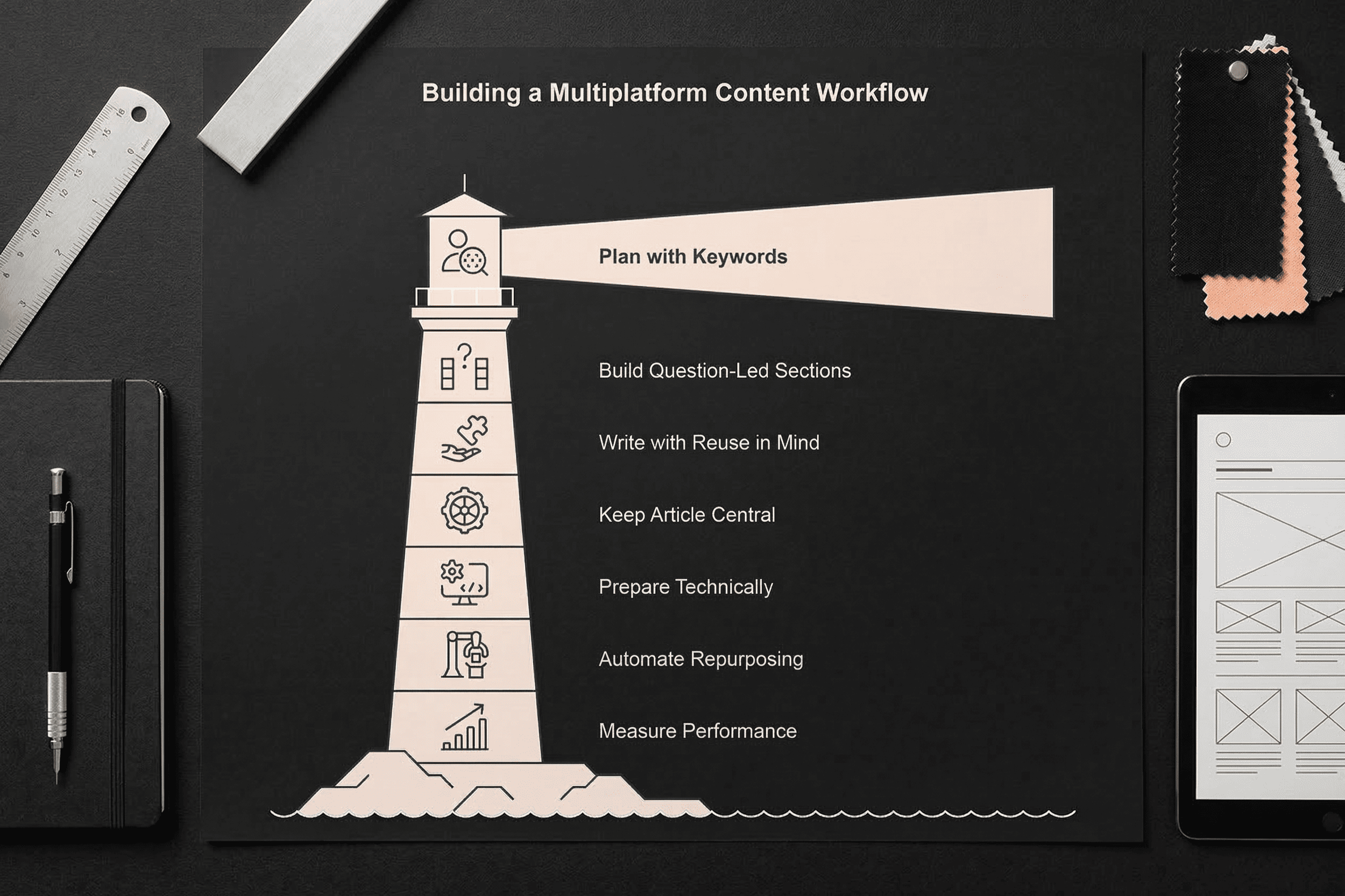
Building a Multiplatform Content Workflow
Plan with Keywords
Build Question-Led Sections
Write with Reuse in Mind
Keep Article Central
Prepare Technically
Automate Repurposing
Measure Performance
Start with the article as the source.
One strong blog post should carry more than one channel.
The article should be treated as the central content asset, not just another post in a queue. When structured properly, it becomes the source of truth for search visibility, AI-readable answers, social repurposing, and short-form outputs.
Write with reuse in mind
Instead of writing a long article first and deciding what to extract later, plan each section so it can stand on its own. That makes the article easier to scan, easier to repurpose, and easier to maintain over time.
Build around real questions
The strongest content starts with what people actually ask. Question-led sections create a cleaner reading experience and give the article stronger search intent alignment from the beginning.
Keep the article central
Social posts, video captions, snippets, and short summaries should all point back to the main article. That keeps authority concentrated around the original page rather than scattering it across disconnected fragments.

Content Repurposing Funnel
Plan for Reuse
Build Around Questions
Keep Article Central
Research should shape the article before the writing starts.
Keywords, question banks, and intent clusters give the article its structure.
A multiplatform article works better when the planning is handled in clusters instead of one-off keywords.
Priority keyword clusters
Group related search terms under one clear topic so each article section can target a defined question, phrase set, or decision stage.
Conversational question banks
Use natural-language questions as H2 or H3 prompts. This improves readability and makes each section more useful for search, answer engines, and repurposed assets.
Intent mapping
Separate questions by awareness, consideration, and decision stage so the article can guide different types of readers without losing structure.
Preferred extract formats
Identify early whether a section is best expressed as a paragraph answer, a short list, a table, a comparison block, or a short how-to.
Make the article readable for people and retrievable for systems.
Structure is what turns long-form content into working content.
A modern blog article needs to perform well for human readers, search crawlers, and AI retrieval systems at the same time.
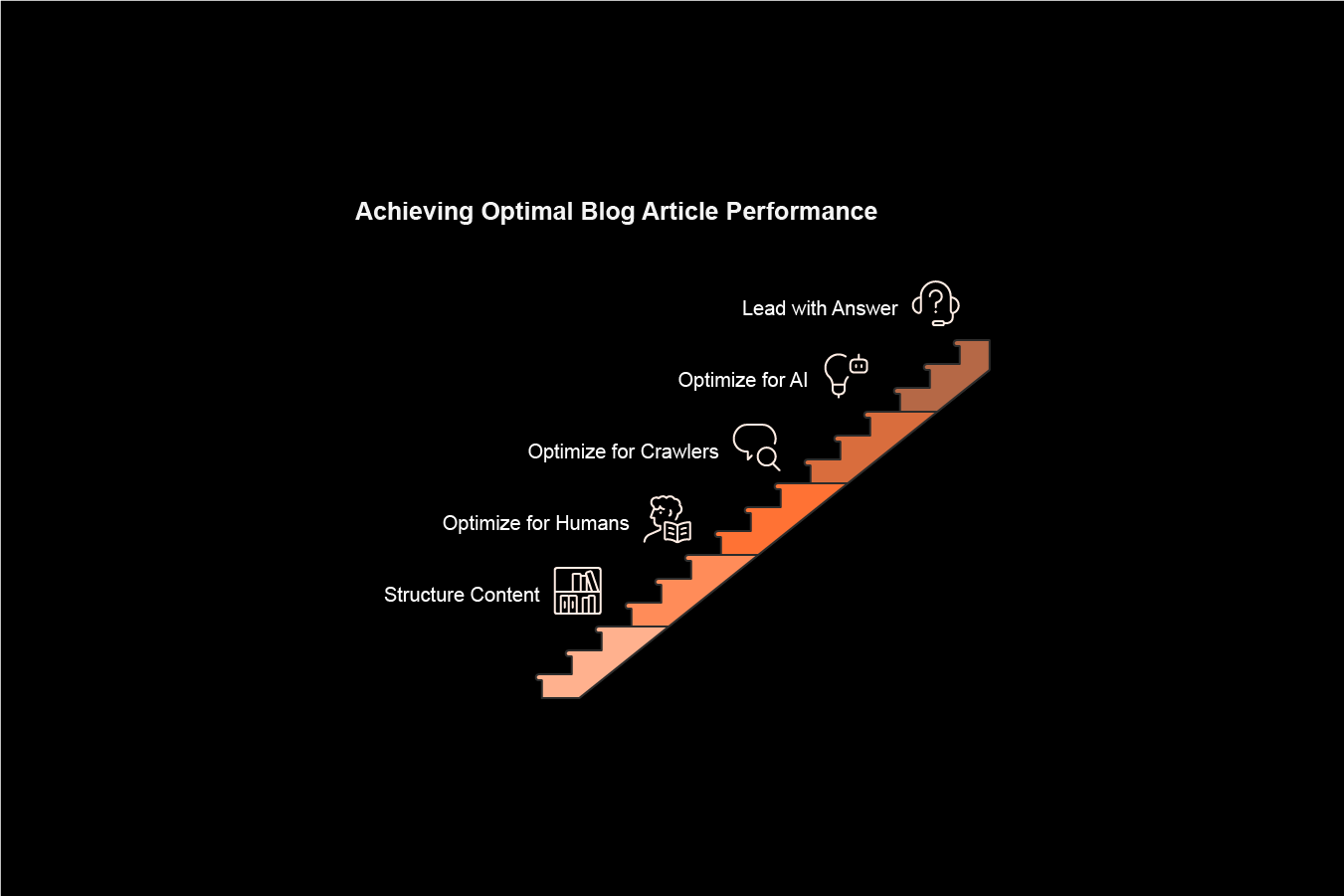
Achieving Optimal Blog Article Performance
Structure Content
Optimise for Humans
Optimise for Crawlers
Optimise for AI
Lead with Answer
Lead with the answer.
Starting with the answer improves scannability and gives the section immediate value. It also creates a cleaner extraction point for answer-led discovery surfaces.

Content Optimisation Pyramid
Structure - Organises content for readability and retrieval
Readability - Ensures content is easy for humans to understand
Retrievability - Makes content easily accessible for systems
Versatility - Allows content to be adapted for various formats
Use lists and steps deliberately.
Lists, tables, and short procedural blocks help break complexity down without losing depth. They also translate easily into slides, summaries, and visual posts.
One article should become a publishing cycle.
The article is not the endpoint. It is the start of the distribution layer.
Once the long-form article is in place, each section can generate further outputs without starting a new research process.
Social-ready summaries.
Each section can include a short TL;DR line that becomes caption material, carousel copy, or a short recap post.
Short video hooks.
The first answer sentence under each section can act as the opening line for a 15 to 60 second video.
Slide-friendly bullets.
Supporting lists convert directly into visual post slides without needing a second interpretation pass.
Search and answer support.
Because the same section is already structured with question, answer, and proof, it also stays useful for search visibility and AI extraction.

Article to Content Conversion Funnel
Section Extraction - Breaking down the article into manageable sections
Social Summaries - Creating short, engaging summaries for social media
Video Hooks - Developing concise opening lines for videos
Slide Bullets - Converting lists into visual presentation slides
Search Support - Structuring content for search engine optimisation
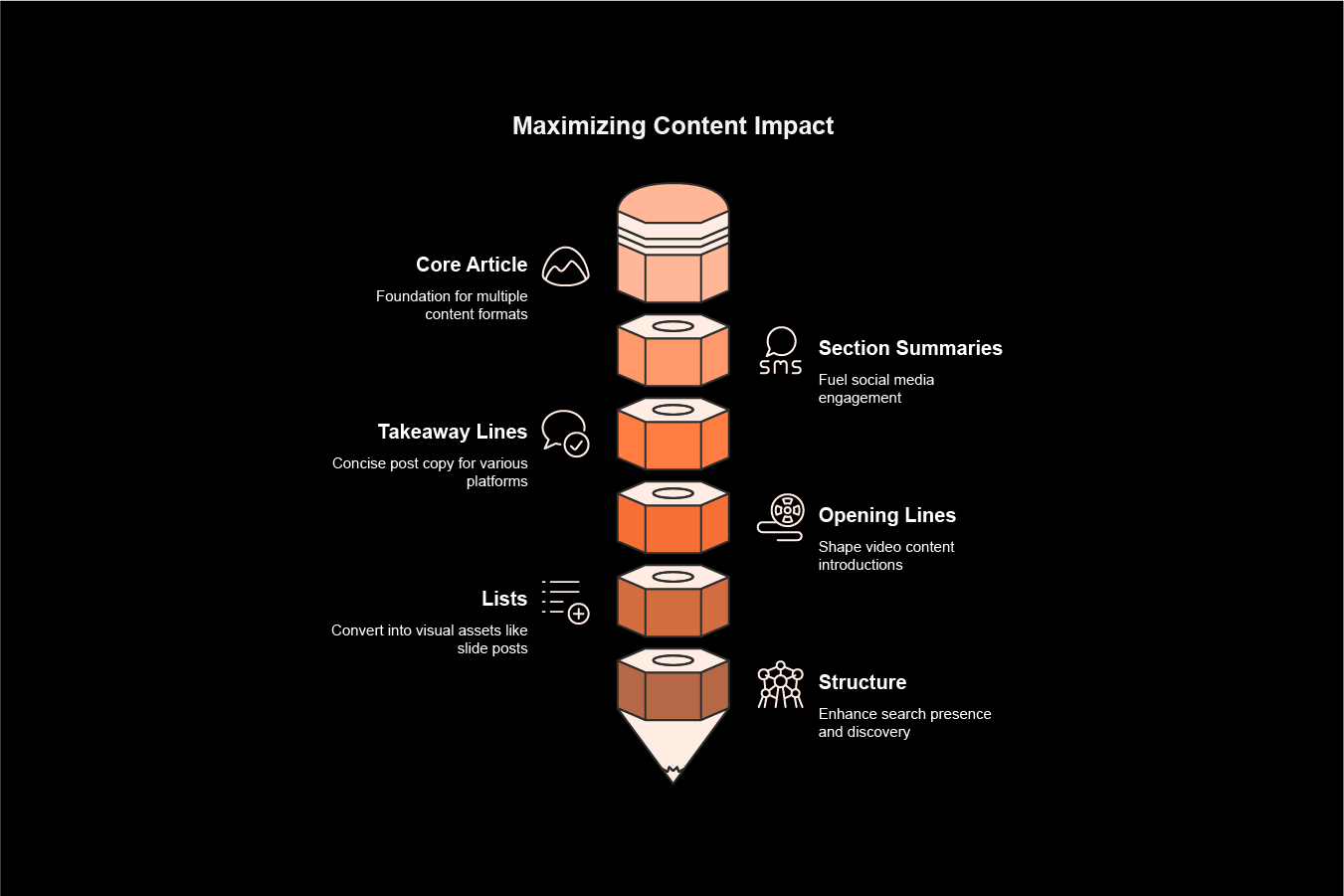
Maximising Content Impact
Core Article - Foundation for multiple content formats
Section Summaries - Fuel social media engagement
Takeaway Lines - Concise post copy for various platforms
Opening Lines - Shape video content introductions
Lists - Convert into visual assets like slide posts
Structure - Enhance search presence and discovery

Creating a Repeatable Distribution System
Strong Page - A well-structured long-form article
Short Summaries - Concise recaps of each section
Section Openers - Engaging introductions to each section
Key Points - Compact supporting points within sections
Keep the article technically prepared.
Good writing performs better when the page is easier to parse, label, and trust.
The article should be supported by markup and metadata that reinforce its structure.
Use schema where the content genuinely supports it.
FAQPage for question blocks, HowTo for procedural sections, and Article or BlogPosting for the full page help define the content more clearly.
Keep critical content in visible HTML.
The answer text should not be hidden behind scripts or interface logic. Important sections need to be readable without additional rendering barriers.
Show authorship and freshness.
Author information, dates, and visible update signals help strengthen trust and make the article easier to validate as a maintained source.
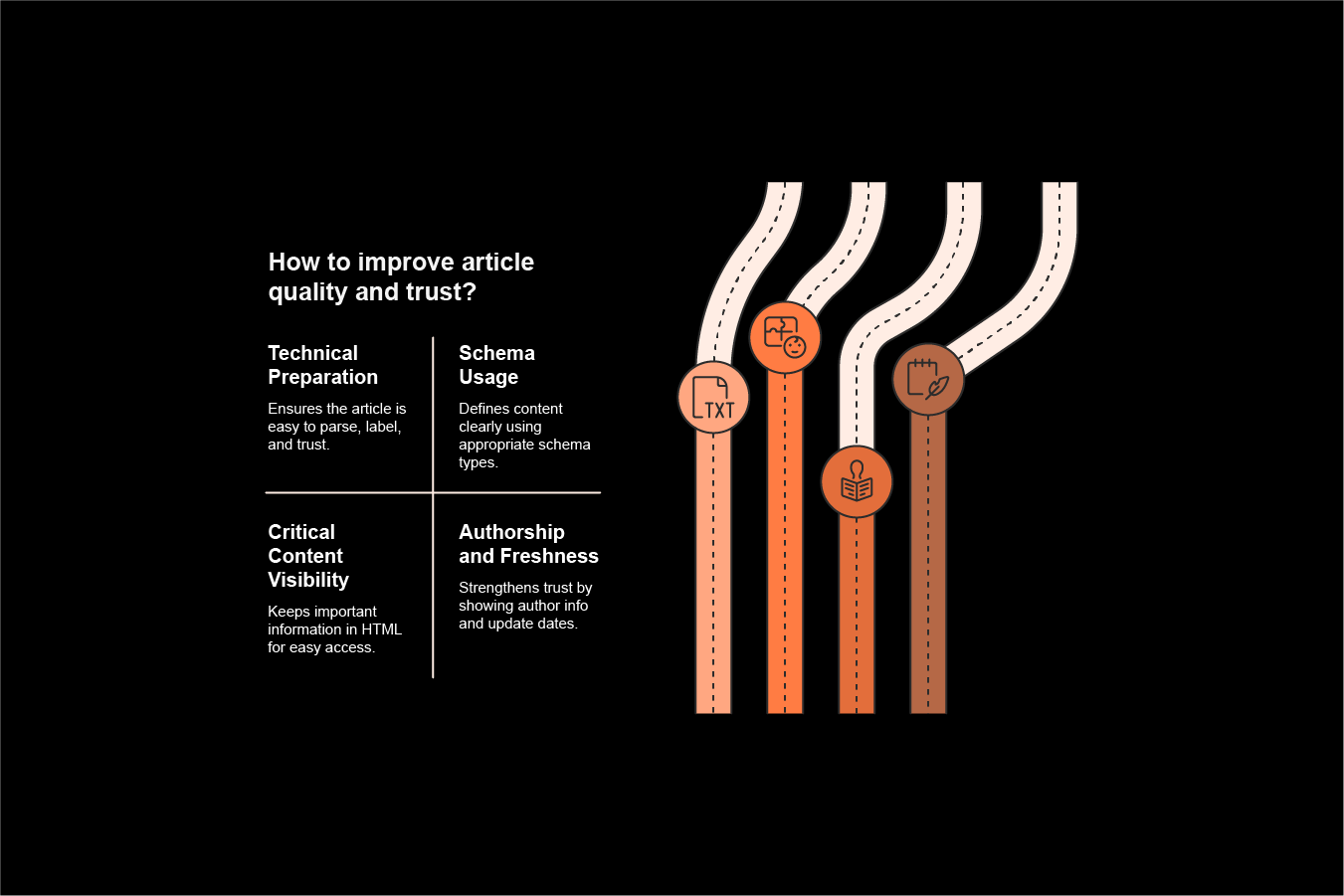
How to improve article quality and trust?
Technical Preparation - Ensures the article is easy to parse, label, and trust.
Schema Usage - Defines content clearly using appropriate schema types.
Critical Content Visibility - Keeps important information in HTML for easy access.
Authorship and Freshness - Strengthens trust by showing author info and update dates.
Tooling should remove repetition, not replace judgment.
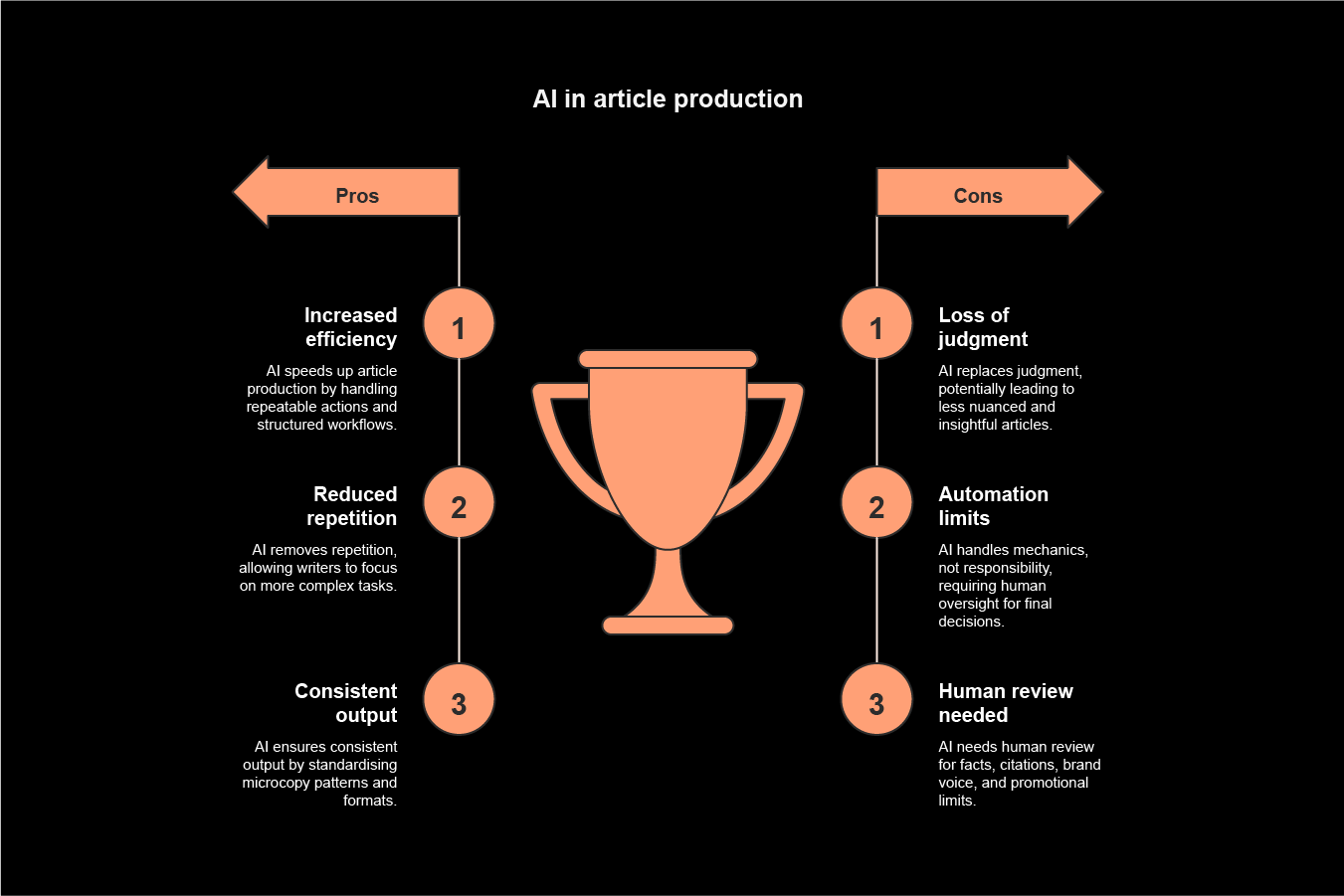
AI in article production
Pros:
1. Increased efficiency - AI speeds up article production by handling repeatable actions and structured workflows.
2. Reduced repetition - AI removes repetition, allowing writers to focus on more complex tasks.
3. Consistent output - AI ensures consistent output by standardising microcopy patterns and formats.
Cons:
1. Loss of judgement - AI replaces judgement, potentially leading to less nuanced and insightful articles.
2. Automation limits - AI handles mechanics, not responsibility, requiring human oversight for final decisions.
3. Human review needed - AI needs human review for facts, citations, brand voice, and promotional limits.
Automation works best when it handles the mechanics, not the responsibility.
AI and automation can help speed article production, but the article still needs editorial ownership.
Use automation for repeatable actions.
Outlines, section expansions, social variants, and exports can all be accelerated with templates and structured workflows.
Keep humans on evidence and final sign-off.
Facts, citations, brand voice, product detail, and promotional limits still need human review.
Standardise microcopy patterns.
Using one consistent answer block, one TL;DR format, and one FAQ pattern reduces revision time and keeps the article more predictable across outputs.
Measure the article as a source asset.

Article Source Asset Measurement
Search Visibility - Tracks impressions and click-through rate
Answer Visibility - Monitors answer presence and AI citations
Distribution Output - Generates social posts and assets
Conversion Quality - Supports sign-ups and commercial actions
A stronger article should improve more than one metric.
A multiplatform article should be measured across several layers, not only traffic.
Search visibility - Track impressions, rankings, click-through rate, snippet appearances, and organic sessions.
Answer visibility - Monitor answer presence, AI citations, featured snippet lift, and query-level extraction where possible.
Distribution output - Measure how many social posts, scripts, slides, and short assets one article can generate without additional research.
Conversion quality - Track whether the source article and its repurposed outputs support sign-ups, enquiries, or downstream commercial actions.
This gives the article value as a system asset, not only a publishing asset.
Why this matters now.
The strongest content workflows begin with one dependable long-form source.
In a fragmented discovery environment, the article still matters, but not in isolation. It matters because it can act as the anchor for search, AI-readable answers, short-form outputs, social distribution, and update-led maintenance.
When one article is written as a collection of clear, answer-led sections, it becomes easier to publish, easier to repurpose, and easier to manage over time. That gives content teams a more sustainable rhythm and gives the article itself a longer working life.
-
It is a process where one long-form blog article is written as the central source asset, then repurposed into social posts, short videos, summaries, FAQs, and other supporting formats.
-
Because it makes the section easier to scan, easier to extract, and easier to reuse. It also improves the article’s usefulness for search and answer-led discovery.
-
A six-section article can realistically generate an overview post plus six section-led posts, short video hooks, FAQ entries, summary copy, and additional repurposed assets from the same source material.
-
Article or BlogPosting is the base layer, with FAQPage and HowTo added where the content structure genuinely supports them.
-
No. A smaller team usually benefits more from a lean setup: one CMS, one drafting workflow, one export process, and one scheduling layer with light automation.
-
Fast-moving topics should be reviewed more frequently, often every 4 to 8 weeks. More evergreen topics can be checked every 6 to 12 months depending on accuracy and performance.
-
Start with visibility, repurposing output, and conversions. That gives a clearer view of whether the article is working as both a search asset and a content source asset.
“A strong article should not only publish well, it should keep producing value after publication”
The real advantage of a multiplatform workflow is not simply output volume. It is having one dependable source that can feed search, support answer visibility, create repurposed content, and remain manageable over time. That makes the article more useful as content, and more useful as infrastructure.
Read each of these dedicated articles for greater insight:







Long read