
Monetise the Article, Not Just the Click
Turn long-form articles into section-based content assets that keep generating reach, trust, and revenue opportunities.
In a zero-click environment, monetisation depends less on one visit and more on how well one article can create reusable, citation-ready, socially distributable assets.

From Article to Monetisation Asset
Long-Form Article - Single publishing unit
Section-Based Content - Break into reusable assets
Monetisation Calendar - Schedule by section type
Revenue Paths - Support direct sales, data capture, affiliates
Monetisation Asset - Durable revenue-generating asset
Start with articles that already carry value.
Better monetisation begins with better source selection.
Not every article should become part of a monetisation calendar. The strongest candidates already show evidence of demand, topic relevance, or search momentum. That means the first step is not content creation. It is content selection.
Prioritise pages with real audience signal
Use search data, analytics, and on-site behaviour to identify pages that already attract impressions, rankings, or topic-specific interest. Content with existing traction is easier to refresh and easier to monetise.
Favour evergreen structures
How-to pages, product explainers, FAQs, and strong topic primers tend to perform better as source articles because they can be refreshed and republished in parts without rewriting the full piece.
Reduce guesswork with a simple filter
Score each source article by intent fit, freshness, authority, question-led structure, and schema-readiness. That gives the team a practical shortlist instead of an abstract content backlog.

Content Monetisation Funnel
Select High-Value Articles - Identify articles with demand and relevance
Prioritise Audience Signal - Focus on pages with existing traction
Favour Evergreen Structures - Choose articles that can be easily refreshed
Apply Scoring Filter - Use criteria to create a practical shortlist
Monetisation improves when the article is broken into assets.
One page becomes more valuable when each section can work independently.
A long-form article should not be treated as one large publishing unit. Each section should carry a single answer, a single idea, or a single problem-solution angle that can be extracted into its own content format.
Every section should have a job
One section may educate. Another may qualify intent. Another may present evidence. Another may direct the reader toward a product, newsletter, download, or service.
Each section becomes a reusable content block
That means one article can generate multiple social posts, quote cards, short videos, carousel slides, or CTA-led snippets while still pointing back to the same source.
More outputs from one source improves return
When the same article supports search, social, answer engines, and lead capture, the content becomes more than a traffic asset. It becomes a monetisation asset.
A section-first calendar creates more monetisation paths.
Social scheduling should follow article sections, not random topics.
Instead of filling a calendar with disconnected posts, use the article as the source and distribute its sections across a short publishing cycle.

How to structure a content calendar for effective monetisation?
Anchored Calendar - Maintains message consistency and strengthens the source by focusing on one article.
Social Scheduling by Sections - Ensures social posts align with article content, enhancing consistency.
Section-First Calendar - Creates more monetisation paths by focusing on individual article sections.
Keep the calendar anchored to one article.
That creates consistency in message, makes the source stronger, and ensures that supporting assets reinforce one another rather than competing.
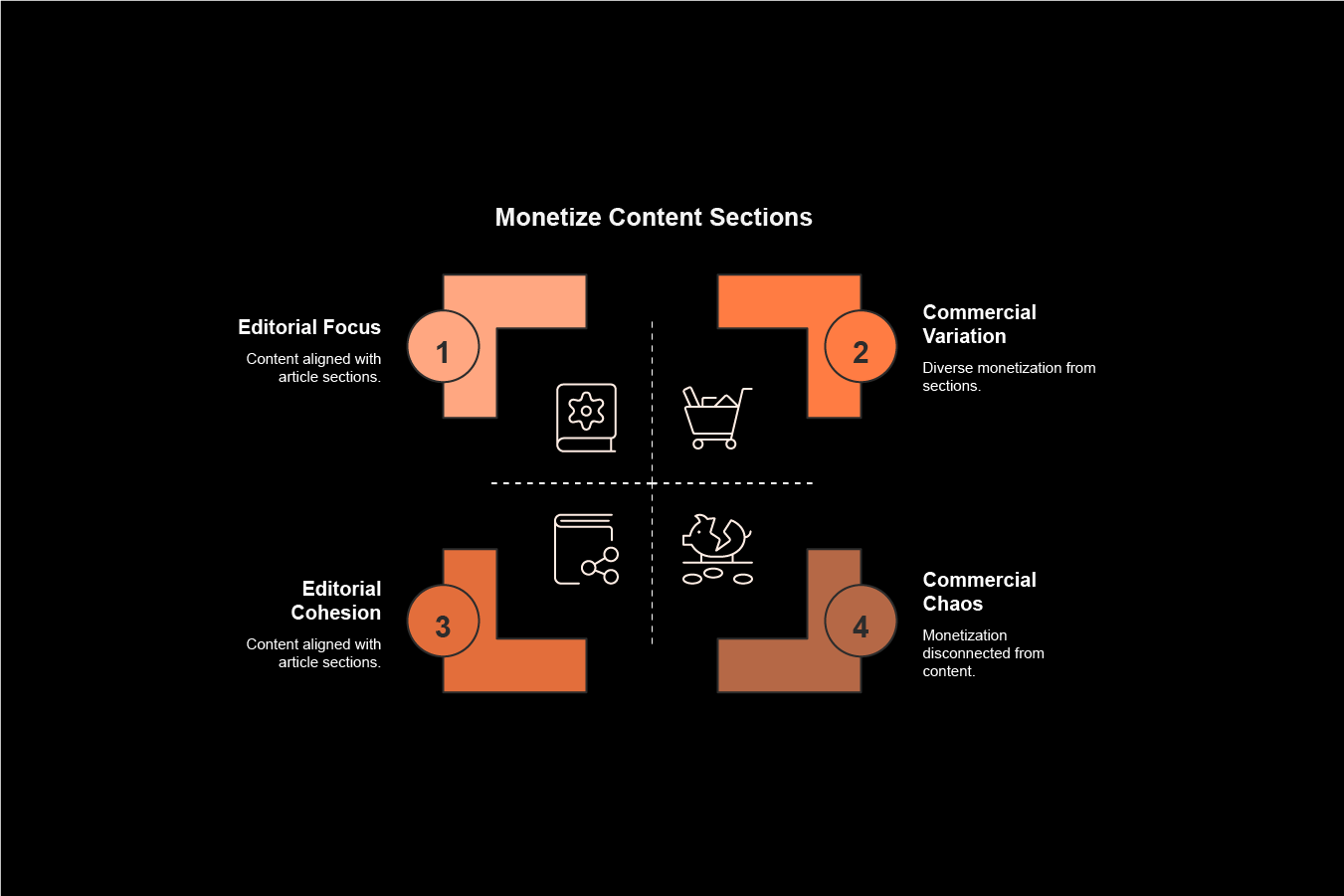
Monetise Content Sections
1. Editorial Focus - Content aligned with article sections.
2. Commercial Variation - Diverse monetisation from sections.
3. Editorial Cohesion - Content aligned with article sections.
4. Commercial Chaos - Monetisation disconnected from content.
Schedule by section type.
One section can become an educational post. Another can become a story-led caption. Another can carry a stronger CTA. This gives the calendar commercial variation without losing editorial cohesion.
The article should support multiple revenue paths.
Monetisation does not have to begin at the bottom of the page.
Different sections can support different outcomes depending on the intent of the reader.
Direct sales pathways.
A section that frames a clear problem can lead into a product, service, or solution page when the fit is obvious and relevant.
First-party data capture.
A section can offer an extended checklist, worksheet, or bonus asset in exchange for an email signup. This is often more durable than chasing the click alone.
Affiliate or sponsor placement.
Educational sections with strong trust and clear utility can support contextual recommendations when the relationship is relevant and transparent.
Conversion by sequencing.
Not every section needs to sell immediately. Some sections build trust, some establish relevance, and some direct toward action. Together they strengthen the revenue path.

Which revenue path should be prioritised in the article?
Affiliate/Sponsor - Supports contextual recommendations with trust.
Data Capture - Durable for long-term engagement through email signups.
Direct Sales - Effective when a clear problem leads to a relevant solution.
Conversion Sequencing - Builds trust and relevance before directing to action.

Monetise Content Effectively
1. Direct Offers - Immediate conversion opportunities
2. Value-Added Solutions - Building trust for future sales
3. Informational Content - Building awareness and interest
4. Trusted Recommendations - Partnering for mutual benefit

Page Monetisation Strategies
Monetisation - Distributed across the reading experience
Email Capture - Bonus resources for signups
Contextual Partnerships - Sponsor or affiliate references
Conversion - The ultimate goal of monetisation
Metadata and schema increase the article’s commercial usefulness.
Monetisation gets stronger when the content is easier to find, summarise, and cite.
A well-structured article becomes more commercially useful when each section includes clean metadata and structured markup.
Add clear metadata per article.
Use a strong title, concise meta description, short slug, canonical path, publish and update dates, tags, and visible author information.
Add answer-friendly markup where relevant.
Article or BlogPosting should support the page as standard. FAQPage and HowTo can strengthen sections that answer specific questions or process-led topics.
Keep section summaries short and extractable.
A short TL;DR beneath each heading helps both readers and retrieval systems understand the point quickly.
Make the content machine-friendly.
Plain HTML answers, logical headings, and concise summaries make the article easier to reuse across search, AI summaries, and social extraction workflows.

Article Commercial Usefulness
1. Metadata - Clear metadata per article enhances commercial usefulness.
2. Markup - Answer-friendly markup strengthens sections and improves commercial value.
3. Summaries - Short, extractable section summaries improve reader and system understanding.
4. Machine-Friendly - Plain HTML, logical headings, and concise summaries make content reusable.
Social repurposing should stay close to the commercial goal.
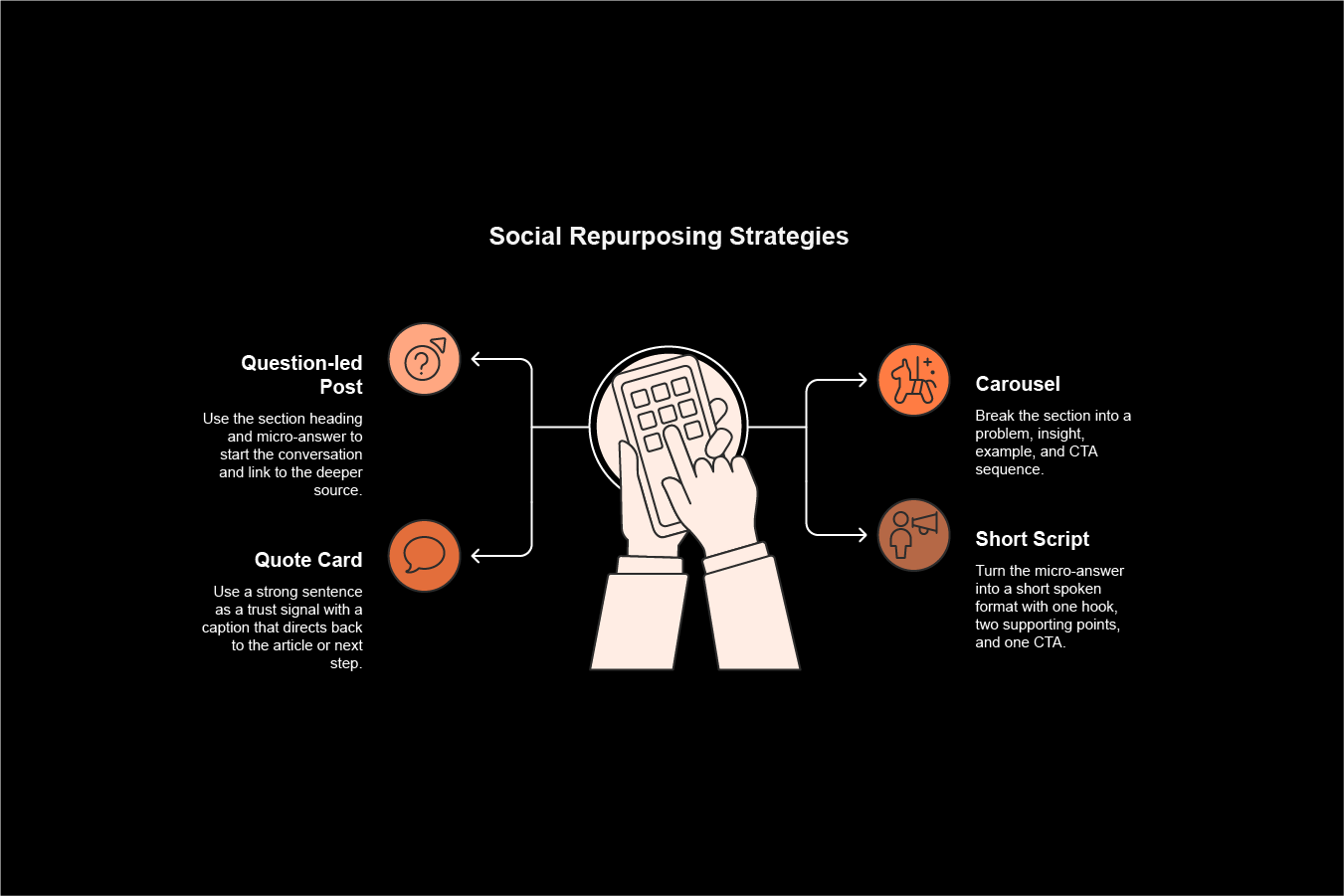
Social Repurposing Strategies
Question-led Post - Use the section heading and micro-answer to start the conversation and link to the deeper source.
Quote Card - Use a strong sentence as a trust signal with a caption that directs back to the article or next step.
Carousel - Break the section into a problem, insight, example, and CTA sequence.
Short Script - Turn the micro-answer into a short spoken format with one hook, two supporting points, and one CTA.
More content only matters when it supports a measurable outcome.
Every section-derived asset should link back to a real destination or action.
Question-led post - Use the section heading and micro-answer to start the conversation and link to the deeper source.
Carousel - Break the section into a problem, insight, example, and CTA sequence.
Quote card - Use a strong sentence as a trust signal with a caption that directs back to the article or next step.
Short script - Turn the micro-answer into a short spoken format with one hook, two supporting points, and one CTA.
This keeps repurposing operationally efficient while protecting the article’s commercial role.
A strong QA process protects both credibility and conversion.

QA Process Challenges
Scaling Publishing - Fast, dependable review needed
Automated Checks - Standardises basic checks
Human Checks - Handle judgment and nuance
Summarisation Checks - AI compression errors detected
Fast QA - Prevents expensive mistakes
Monetised content has to remain accurate, usable, and on-brand.
Scaling section-based publishing requires a fast but dependable review process.
Automated checks should handle the basics
Grammar, plagiarism, metadata presence, image alt text, and formatting checks can all be standardised.
Human checks should handle judgment
Facts, citations, tone, implied claims, and CTA alignment still require human review.
Summarisation checks matter too
If an AI summariser compresses the section incorrectly, the section probably needs rewriting. That is a useful early warning sign before the content spreads across other surfaces.
Fast QA prevents expensive mistakes
A light review pass now is cheaper than cleaning up misleading, weak, or commercially confusing content later.
Why this matters now.
In a zero-click environment, the article has to earn more than traffic.
Search and AI systems increasingly surface answers before they send clicks. That changes how monetisation works. The article now needs to do more than rank. It needs to provide extractable answers, strengthen brand authority, create social distribution opportunities, and guide users toward commercial actions even when the first interaction happens elsewhere.
A section-based social calendar helps make that possible. It turns one article into a set of reusable assets, keeps the message coherent across channels, and gives each section a job inside a wider revenue system.
-
It is a publishing workflow where each H2 or H3 from a long-form article becomes its own reusable social asset, such as a post, carousel, quote card, or short script.
-
Because one article can support several commercial paths at once, including product clicks, lead capture, newsletter signups, affiliate placements, or service enquiries.
-
Start with evergreen or high-traffic pages that already show search interest, stable impressions, or strong topic relevance. Then score them for structure, freshness, and repurpose potential.
-
A micro-answer is a short 20 to 50 word response placed directly below a section heading. It captures the core point quickly and makes the section easier to reuse.
-
Article or BlogPosting is the core layer, with FAQPage and HowTo added where sections naturally support those structures.
-
Begin with visibility, engagement, and conversion signals. That usually means impressions, saves, referral clicks, signups, or other commercial outcomes tied to the section CTA.
-
Partially. Exports, metadata drafts, captions, basic checks, and scheduler handoffs can be automated. Facts, tone, and commercial accuracy still need human review.
“A stronger article does more than attract attention, it creates more places for value to be discovered, reused, and converted”
Monetisation in 2026 depends less on isolated clicks and more on how clearly a brand can structure, distribute, and reuse its expertise across different surfaces. A section-based article system helps turn long-form work into a more durable revenue asset.
Read each of these dedicated articles for greater insight:






Long read