
Repurpose for Answers
Turn every blog section into a social-ready answer asset.
AEO now rewards content that is easy to extract, easy to reuse, and easy to trust.
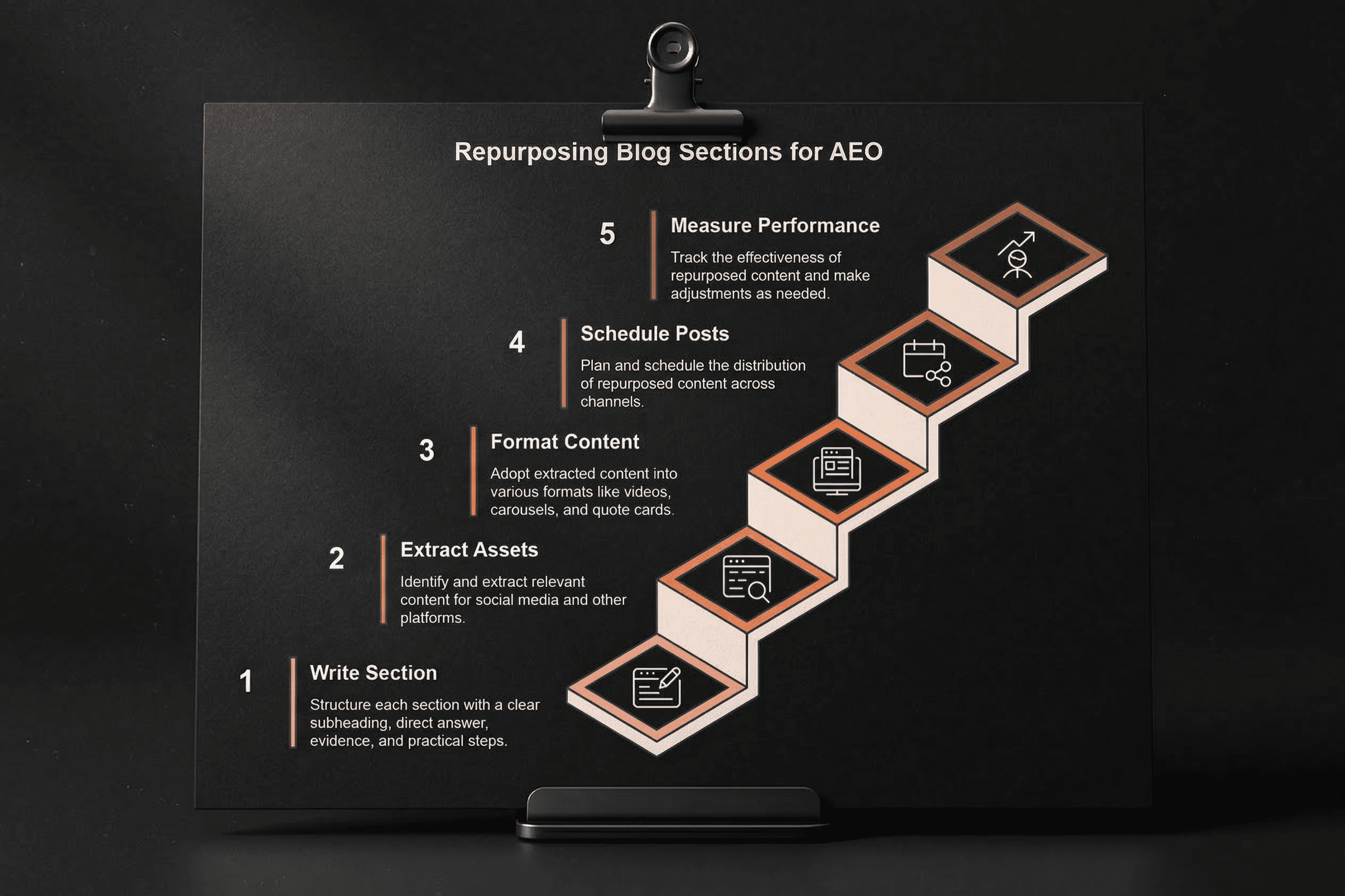
Repurposing Blog Sections for AEO
1. Write Section - Structure each section with a clear subheading, direct answer, evidence, and practical steps.
2. Extract Assets - Identify and extract relevant content for social media and other platforms.
3. Format Content - Adapt extracted content into various formats like videos, carousels, and quote cards.
4. Schedule Posts - Plan and schedule the distribution of repurposed content across channels.
5. Measure Performance - Track the effectiveness of repurposed content and make adjustments as needed.
One article section can do more than one job.
Write once for the page. Publish many times for discovery.
A well-structured article section no longer has to stay inside the article alone. When written with clarity, evidence, and immediate answer value, the same section can support search visibility, social distribution, and AI answer extraction at the same time.
Built for answer-first reading
Each section should begin by resolving the question quickly. That helps human readers understand the value immediately, while also improving the chance of excerpting, snippet use, and AI answer pickup.
Designed for downstream reuse
A section with a clear heading, a one-line answer, supporting evidence, practical steps, and metadata is easier to convert into social assets without reinterpreting the content from scratch.
Better reuse, less content waste
Instead of creating separate ideas for every channel, the article becomes the source layer. Each section feeds short-form outputs while still pointing back to the canonical page.

Unveiling the Multifaceted Power of Article Sections
Article Sections
Search Visibility
Social Distribution
AI Answer Extraction
Answer-First Reading
Downstream Reuse
Content Waste Reduction
Structure sections like standalone answers.
AEO starts at the section level, not just the page level.
Every section should behave like a self-contained answer unit. That means each part of the article needs enough structure to be understood on its own.
Question-led subheading
Use a clear H3 that matches a real search intent, claim, or user question.
Immediate answer line
Follow the heading with one short sentence that answers it directly. This becomes useful for AI answers, hooks, and short captions.
Evidence layer
Add 1 to 3 bullets, facts, proof points, citations, or timestamps that reinforce the answer and strengthen trust.
Practical steps
Include three clear actions, examples, or applications. These convert naturally into slides, scripts, and platform-native teaching formats.
CTA and metadata
Finish with a light call-to-action and attach suggested keywords, slug logic, and descriptive metadata for reuse.
Answer-first content needs answer-first formatting.
A strong section should be readable by people, searchable by engines, and extractable by AI.

Optimising Content for Readability, Searchability, and Extractability
Answer-First Formatting - Structuring content to provide answers upfront
Human Readability - Ensuring content is easy for people to understand
Engine Searchability - Optimising content for search engine visibility
AI Extractability - Making content structured for AI processing
Headings should mirror the real query.
If the heading sounds like something a person would ask, it becomes more useful for search, snippet extraction, and platform hooks.
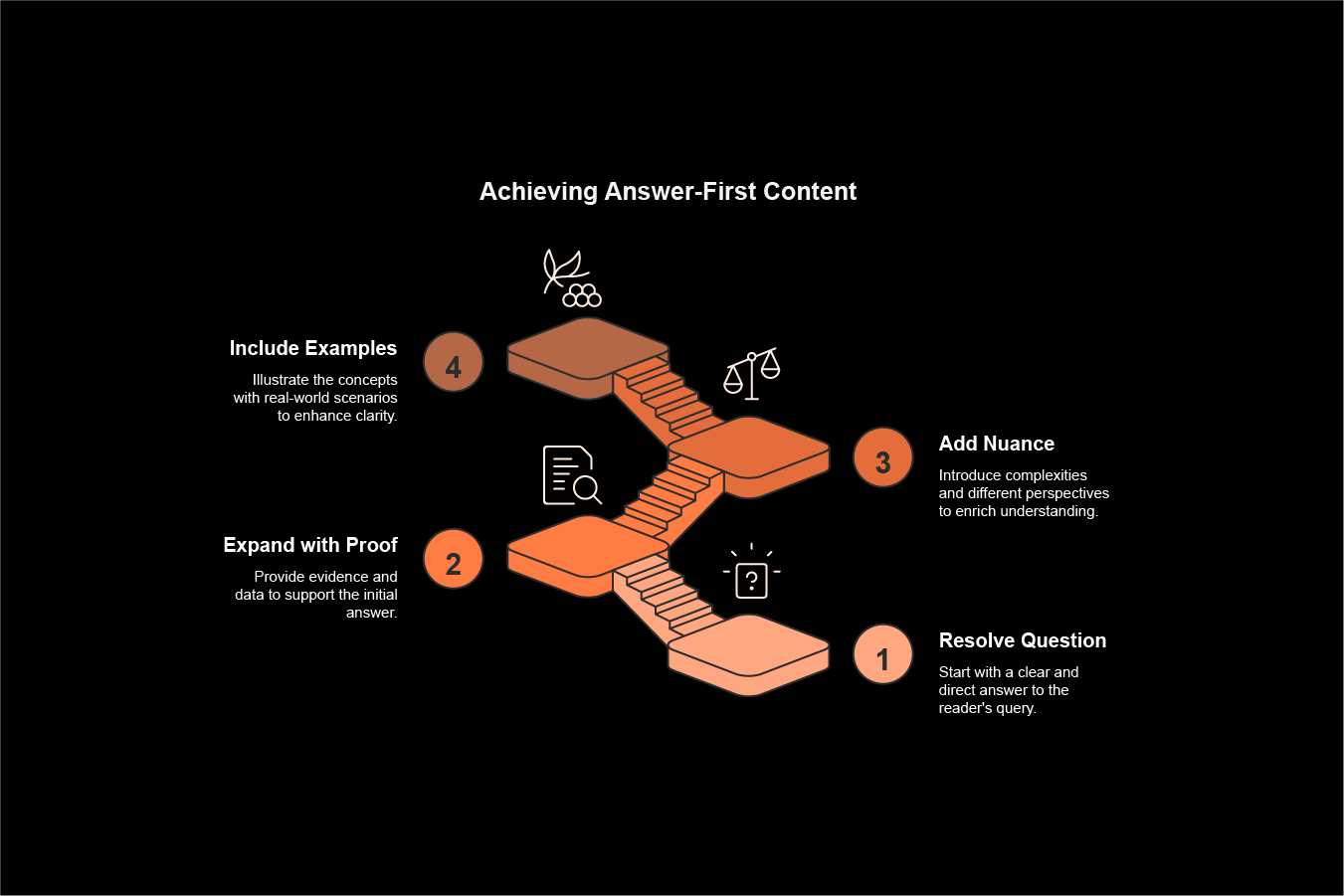
Achieving Answer-First Content
1. Resolve Question - Start with a clear and direct answer to the reader's query.
2. Expand with Proof - Provide evidence and data to support the initial answer.
3. Add Nuance - Introduce complexities and different perspectives to enrich understanding.
4. Include Examples - Illustrate the concepts with real-world scenarios to enhance clarity.
The first sentence should resolve the question.
Do not make the reader wait for the answer. Put the answer first, then expand with proof, nuance, or examples.
AEO depends on metadata as much as copy.
Good repurposing is not only editorial. It is also structural.
Each section should include supporting metadata that makes it easier to publish, track, and reuse correctly.
Add focused metadata per section.
Store keywords, alternate heading variants, social summary text, and short descriptions that can be reused in captions, cards, and distribution tools.
Include FAQ pairs alongside sections.
A small FAQ layer gives answer engines short, direct blocks they can lift cleanly. It also gives content teams ready-made material for captions, voice scripts, and support content.
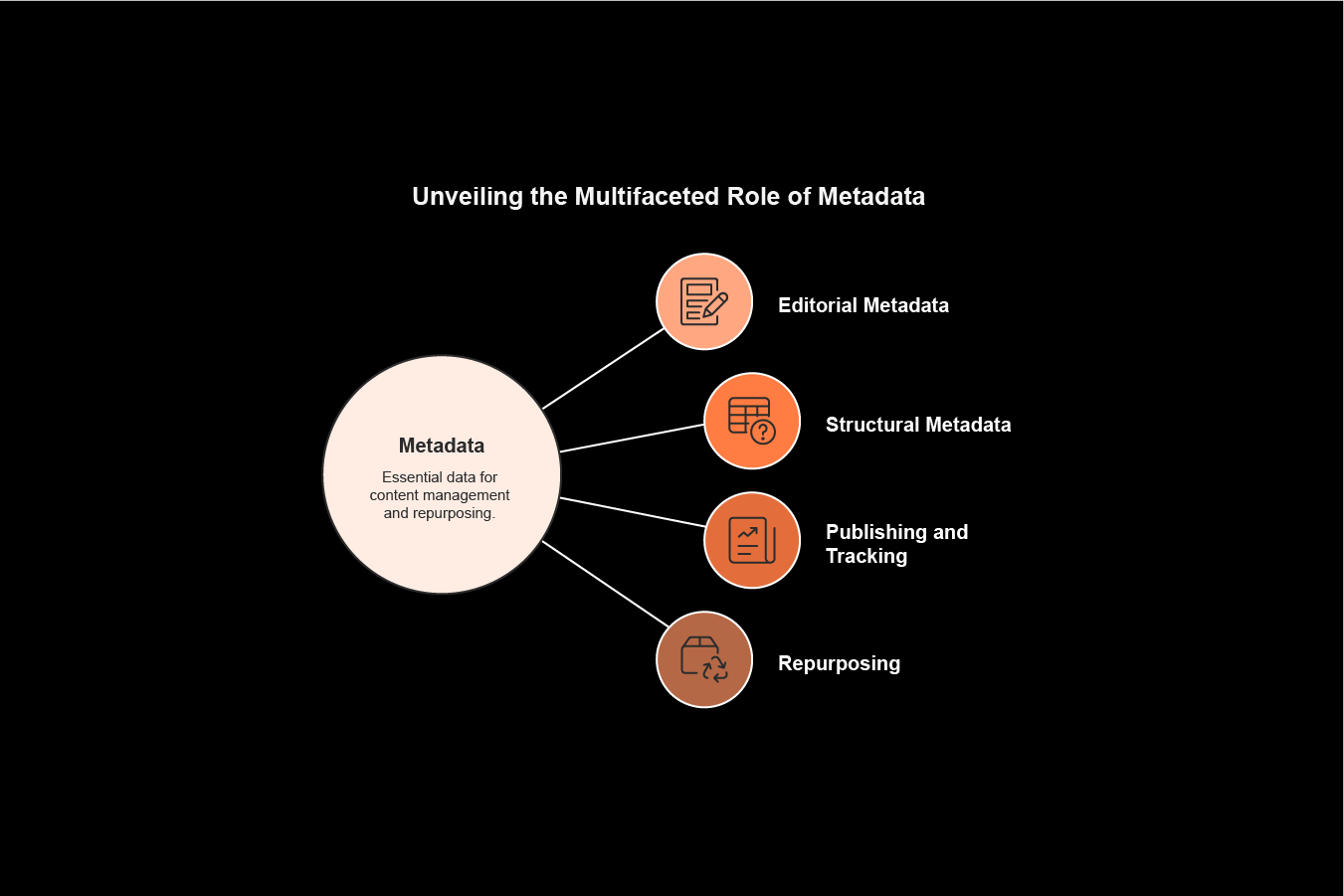
Unveiling the Multifaceted Role of Metadata
Metadata - Essential data for content management and repurposing.
Editorial Metadata
Structural Metadata
Publishing and Tracking
Repurposing
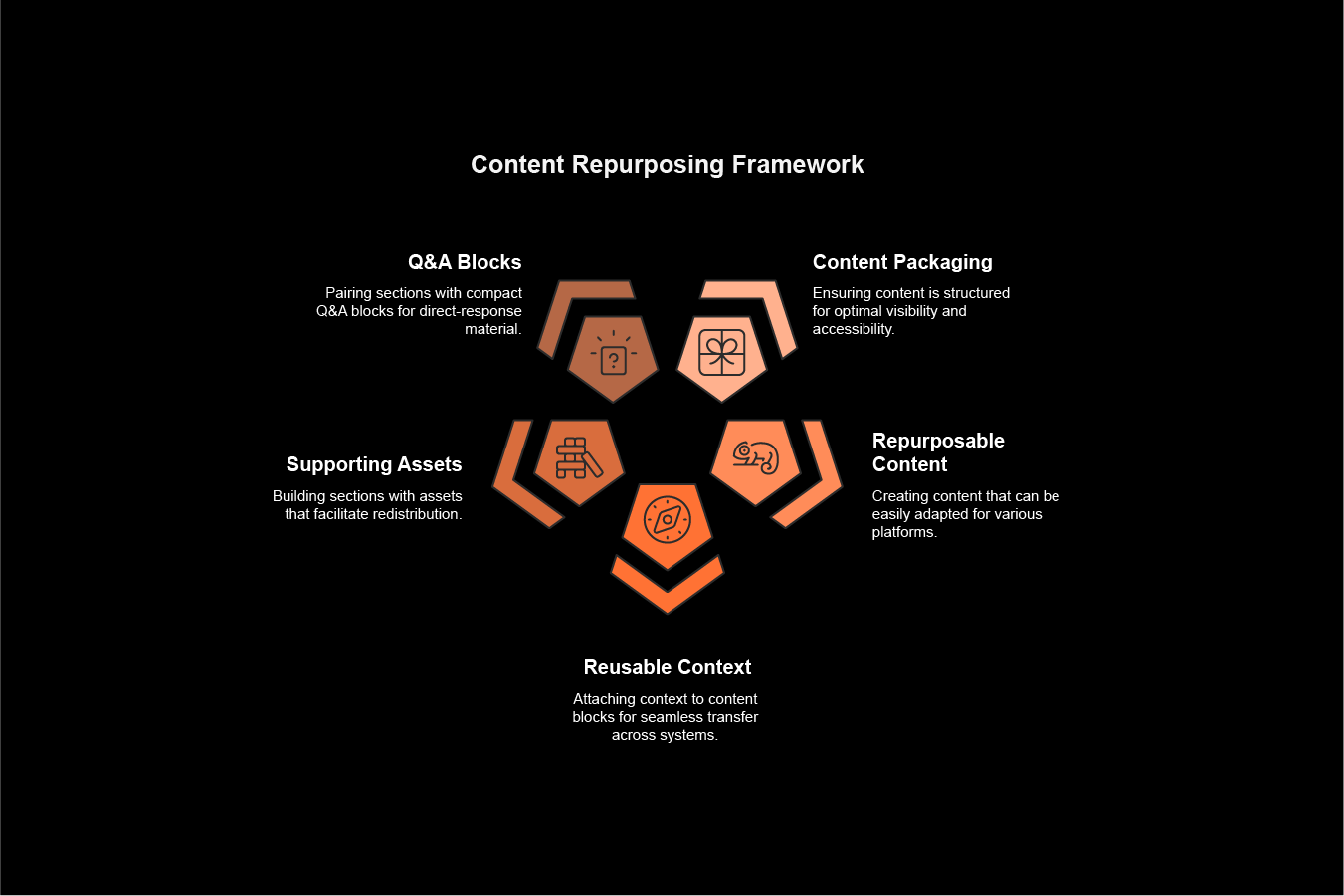
Content Repurposing Framework
Q&A Blocks - Pairing sections with compact Q&A blocks for direct-response material.
Content Packaging - Ensuring content is structured for optimal visibility and accessibility.
Repurposable Content - Creating content that can be easily adapted for various platforms.
Reusable Context - Attaching context to content blocks for seamless transfer across systems.
Supporting Assets - Building sections with assets that facilitate redistribution.
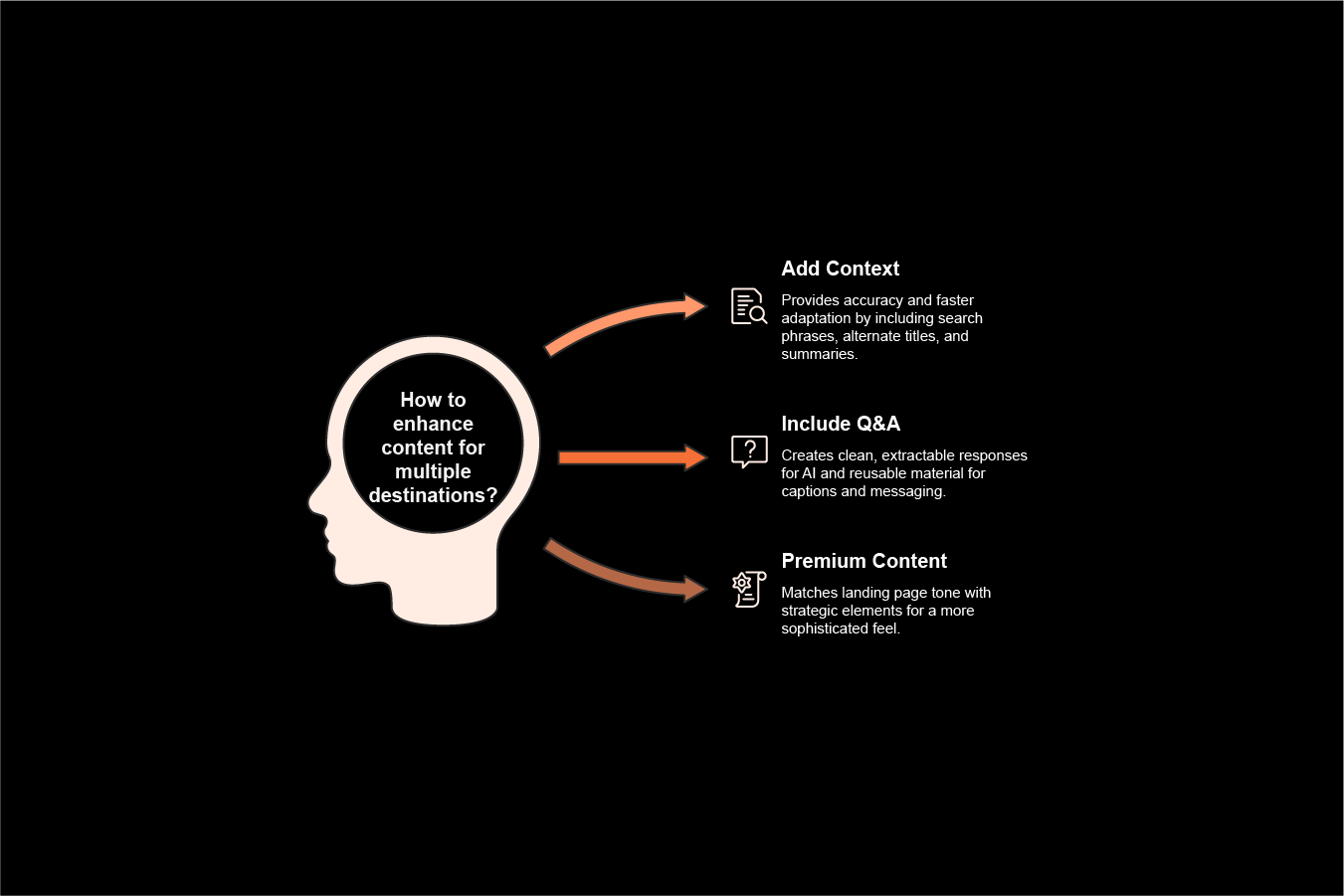
How to enhance content for multiple destinations?
Add Context - Provides accuracy and faster adaptation by including search phrases, alternate titles, and summaries.
Include Q&A - Creates clean, extractable responses for AI and reusable material for captions and messaging.
Premium Content - Matches landing page tone with strategic elements for a more sophisticated feel.
Move through a repeatable four-step flow.
Write, extract, format, schedule.
This process works best when it becomes a standard operating rhythm.
Author the article with section-level structure already in place so each part is independently useful.
Pull out the heading, answer line, bullets, steps, quote, CTA, and metadata into reusable fields or a tracking sheet.
Convert the extracted section into short-form outputs such as a reel, a carousel, a quote card, and platform-specific captions.
Publish the assets over one to two weeks so the same section supports multiple discovery moments without repeating the exact same presentation.
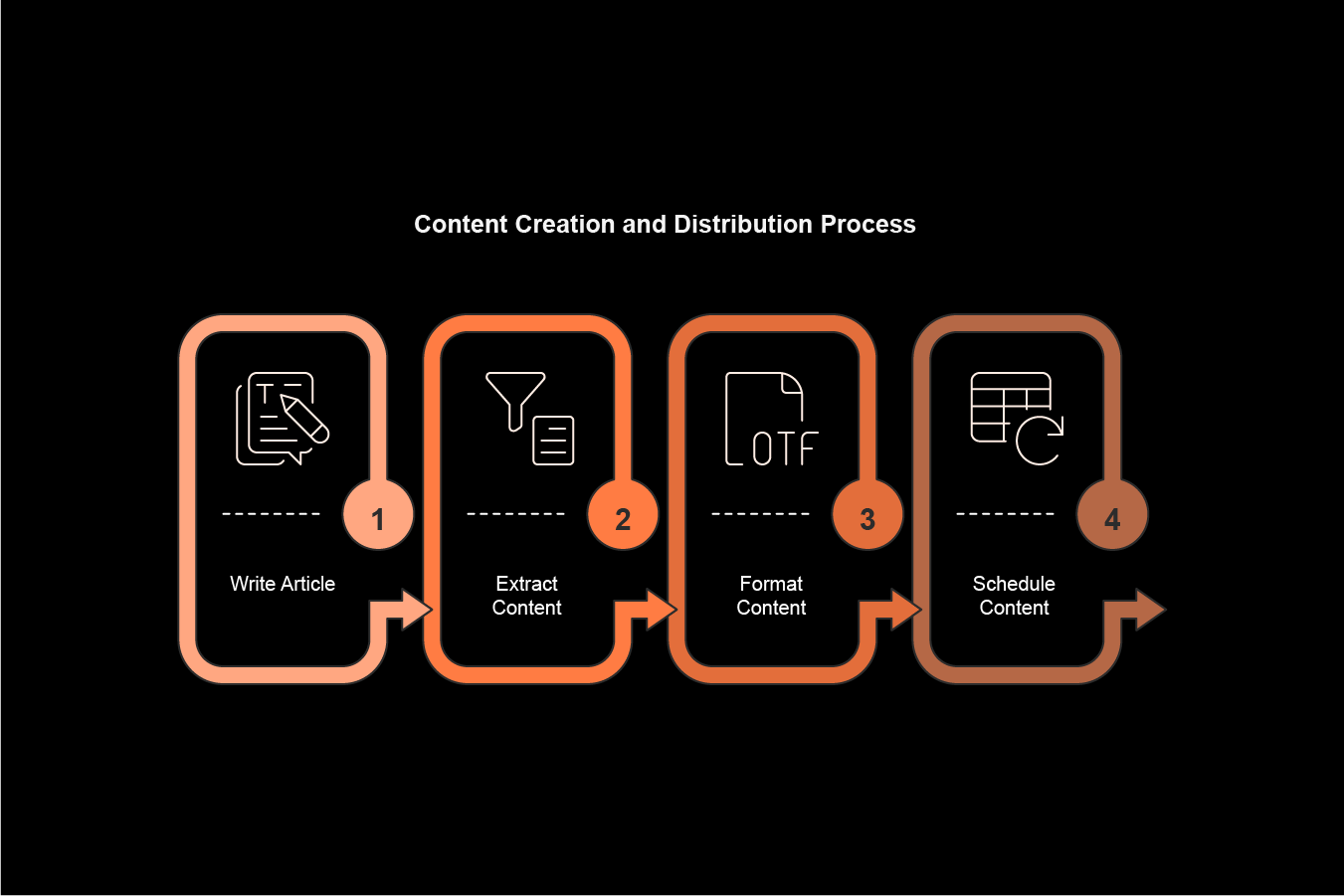
Content Creation and Distribution Process
1. Write Article
2. Extract Content
3. Format Content
4. Schedule Content
Choose the right format for the right section.
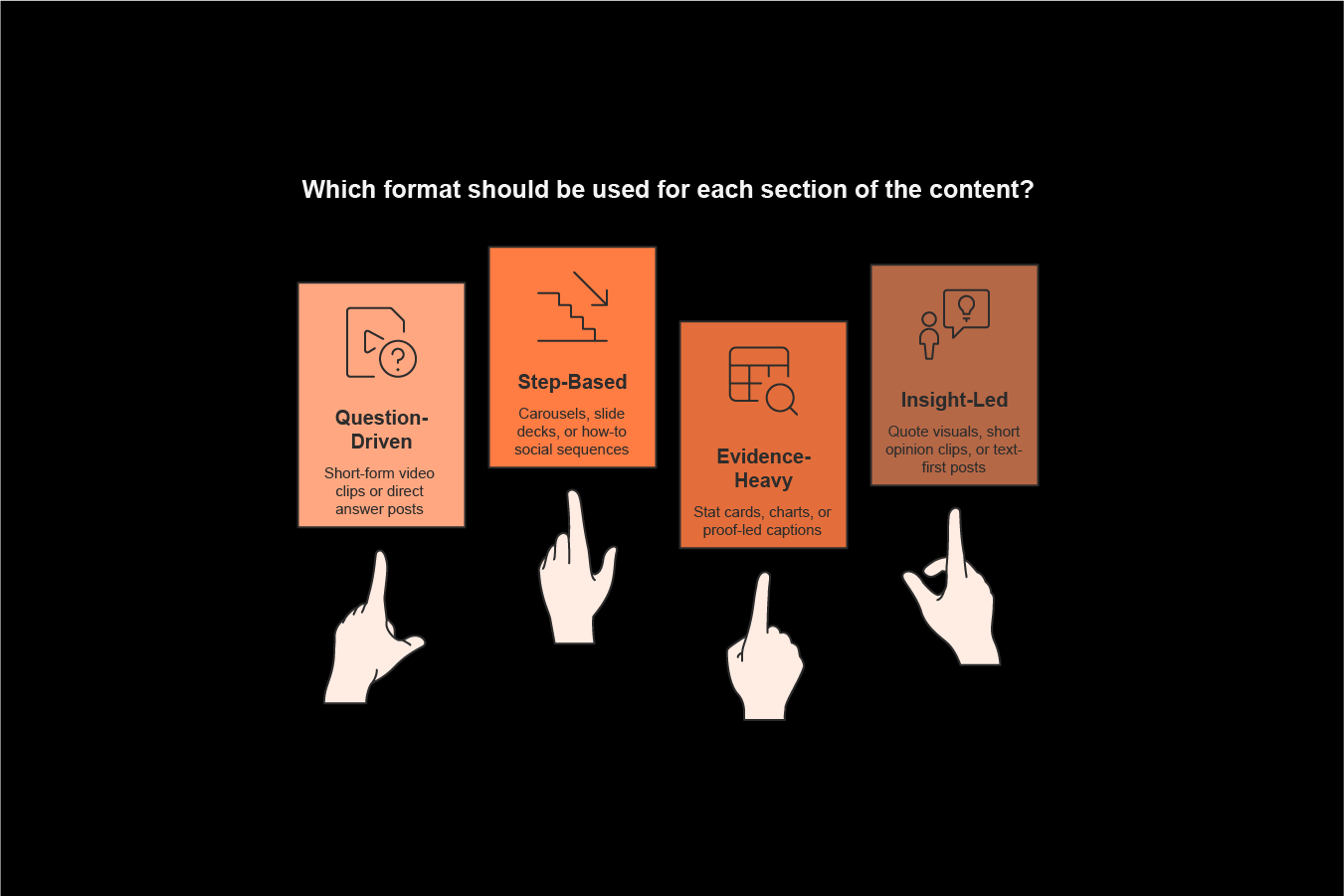
Which format should be used for each section of the content?
Question-Driven - Short-form video clips or direct answer posts
Step-Based - Carousels, slide decks, or how-to social sequences
Evidence-Heavy - Stat cards, charts, or proof-led captions
Insight-Led - Quote visuals, short opinion clips, or text-first posts
Question-driven sections.
Best turned into short-form video clips or direct answer posts.
Step-based sections.
Best converted into carousels, slide decks, or how-to social sequences.
Evidence-heavy sections.
Best used for stat cards, charts, proof-led captions, or authority graphics.
Insight-led sections.
Best turned into quote visuals, short opinion clips, or text-first posts with a strong opening claim.
Preserve the source behind every asset.
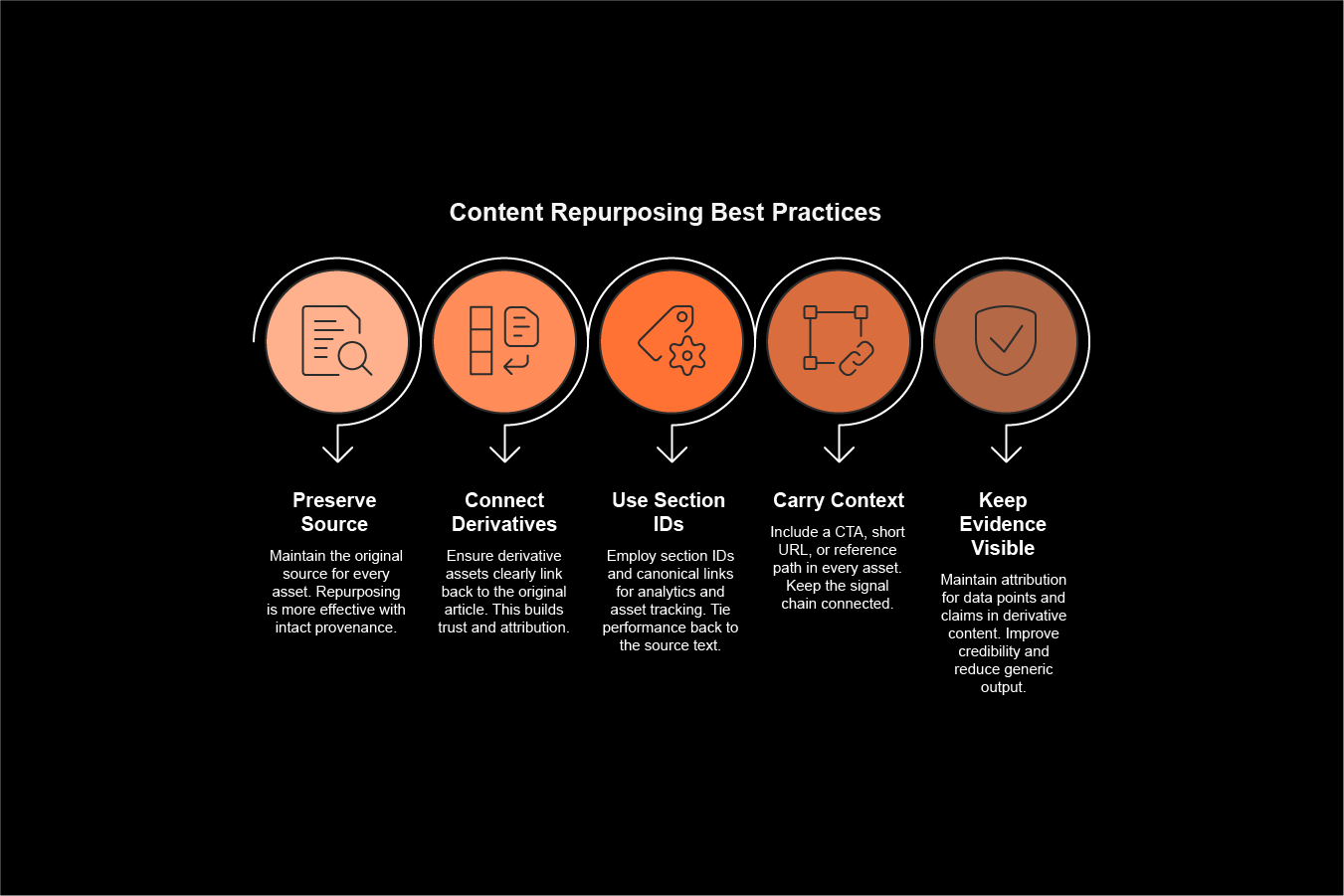
Content Repurposing Best Practices
Preserve Source - Maintain the original source for every asset. Repurposing is more effective with intact provenance.
Connect Derivatives - Ensure derivative assets clearly link back to the original article. This builds trust and attribution.
Use Section IDs - Employ section IDs and canonical links for analytics and asset tracking. Tie performance back to the source text.
Carry Context - Include a CTA, short URL, or reference path in every asset. Keep the signal chain connected.
Keep Evidence Visible - Maintain attribution for data points and claims in derivative content. Improve credibility and reduce generic output.
Repurposing works better when provenance stays intact.
Every derivative asset should clearly connect back to the original article. That improves trust, creates attribution clarity, and strengthens the role of the article as the canonical source.
Use section IDs and canonical links.
Each section should have an identifiable reference so analytics and asset tracking can tie performance back to the source text.
Carry the article context into every post.
Even short assets should include a clean CTA, a short URL, or a reference path back to the full article so the signal chain stays connected.
Keep evidence visible.
If a section includes a data point or claim, maintain attribution in the derivative content where possible. This improves credibility and reduces generic-looking output.
Why this matters now.
In AEO, the section is often the real unit of visibility.
Search and AI systems do not always reward the page as one large whole. They frequently surface a paragraph, a question block, a direct answer, or a small passage that resolves intent quickly. That means the strength of each section matters more than ever.
Repurposing blog sections into social clips is not just an efficiency tactic. It is a way to make each section more useful, more visible, and more reusable across search and social at the same time. A stronger section gives you a better answer asset. A better answer asset gives you more chances to be found.
-
Each section should contain a clear subheading, a direct answer line, evidence or proof points, practical steps, a CTA, and reusable metadata. That structure makes social extraction and AEO formatting much easier.
-
A strong section can usually generate between 3 and 7 primary assets, including a short video script, a carousel, a quote card, and one or two captions.
-
Because answer engines prefer concise, extractable, well-structured responses. A section written with a direct answer, evidence, and clear formatting is easier for AI systems to surface and reuse.
-
Article and FAQPage are the most useful baseline types, with HowTo added where the content includes process-based steps.
-
Start with the exact question, answer it immediately, add one or two supporting points, then close with a simple prompt to read the full article or view the complete guide.
-
Start with impressions, engagement rate, CTR to the article, and social-to-blog conversions. Those give the clearest early signal of whether the repurposing model is working.
-
Automation can help with extraction, formatting, and draft generation, but human review is still important for tone, accuracy, source checking, and overall brand quality.
“The strongest repurposing workflow does not begin with the post, it begins with the section”
AEO is moving content strategy closer to answer design. That means the blog section is no longer just a paragraph within a longer article. It becomes a reusable, measurable, answer-first content unit that can power search visibility, AI extraction, and multi-channel distribution from one original source.
Read each of these dedicated articles for greater insight:







Long read