
Content Domino
Turn one authoritative page into search, AI, and channel-wide visibility.
Content Domino is a source-first publishing model built for modern SEO, AEO, and AI-mediated discovery.
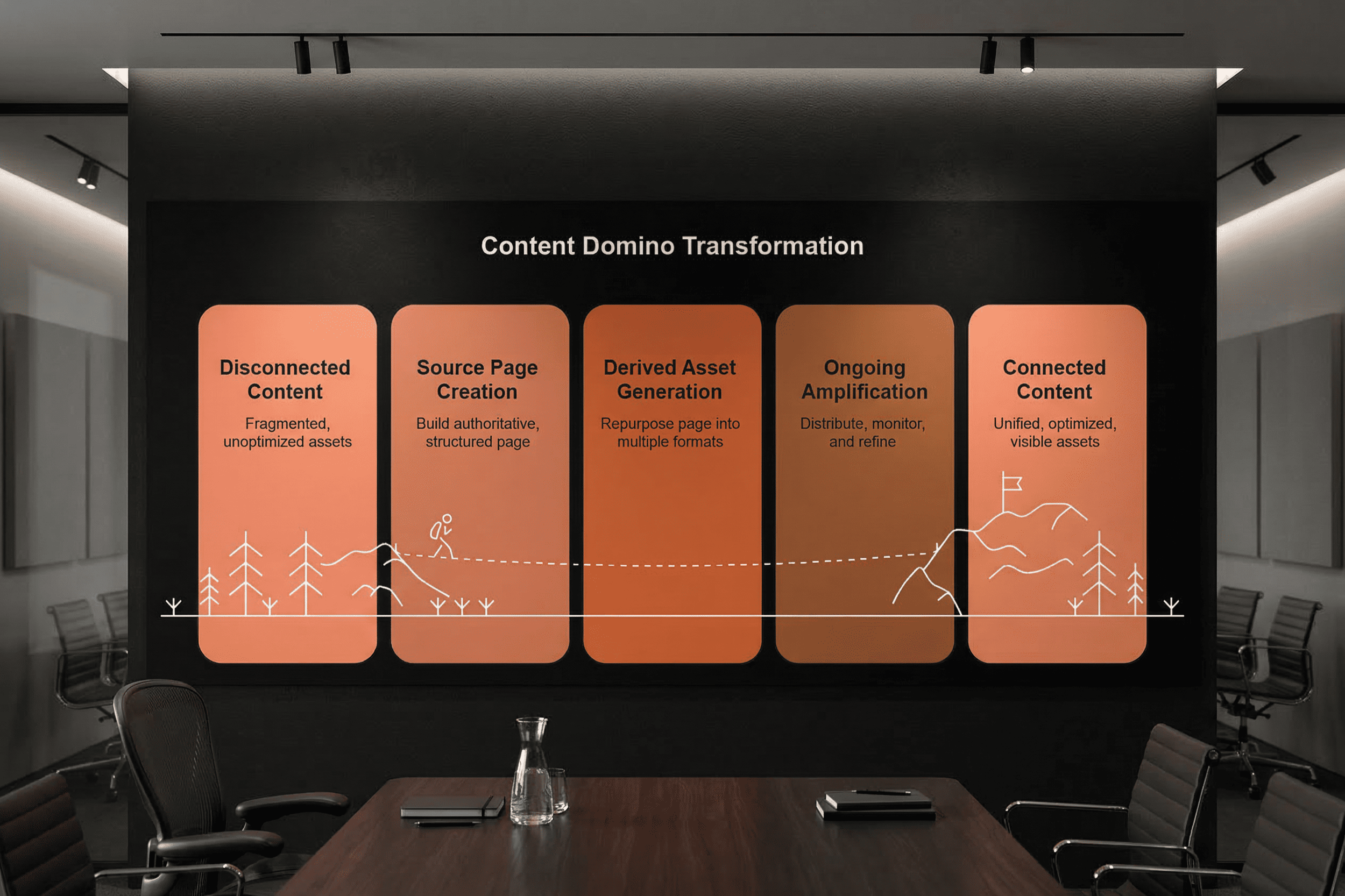
Content Domino Transformation
Disconnected Content - Fragmented, unoptimised assets
Source Page Creation - Build authoritative, structured page
Derived Asset Generation - Repurpose page into multiple formats
Ongoing Amplification - Distribute, monitor, and refine
Connected Content - Unified, optimised, visible assets
A stronger source creates stronger distribution.
Build the page first. Let everything else follow.
Content Domino begins with a simple principle: the page should be the source of truth. Rather than treating social posts, FAQs, and short videos as separate content tasks, it treats them as downstream outputs from one well-structured page.
Start with extractable answers
Each core page should open with a concise answer block that can stand on its own. This helps search engines, AI overviews, voice tools, and answer engines identify a usable response quickly.
Structure for people and machines
Pages should move from direct answer to supporting explanation, using clear headings, logical content sections, and accessible HTML text. This improves readability for users while also making the page easier to parse, index, and cite.
Build for repeat use
When the source page is written properly, it becomes easier to reuse the same material across FAQs, slides, captions, scripts, and internal knowledge workflows without rebuilding the message from scratch.
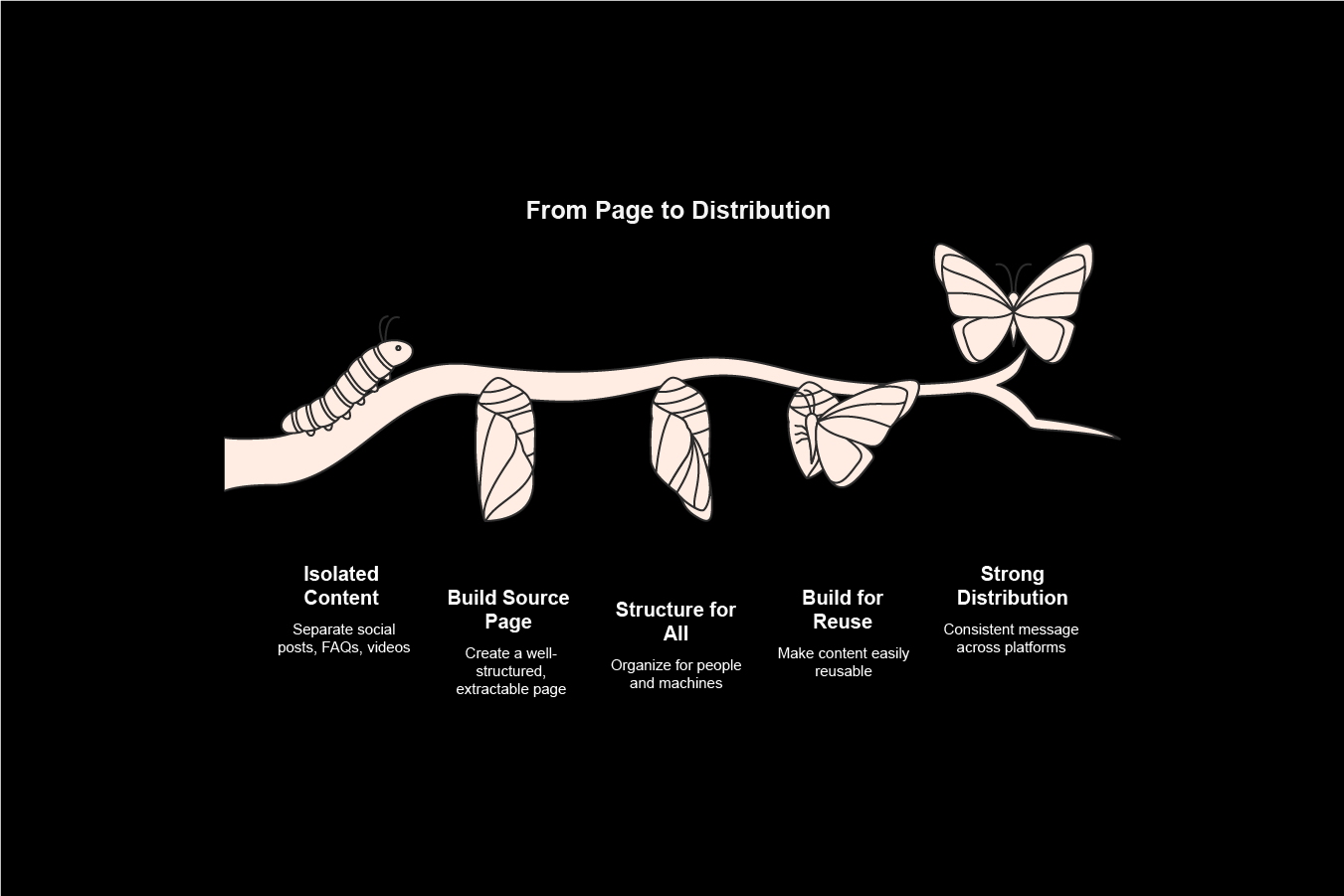
From Page to Distribution
Isolated Content - Separate social posts, FAQs, videos
Build Source Page - Create a well-structured, extractable page
Structure for All - Organise for people and machines
Build for Reuse - Make content easily reusable
Strong Distribution - Consistent message across platforms
From page to presence.
One publishing motion, multiple outcomes.
Content Domino is not just about publishing a page. It is about creating a repeatable system where each page has a wider job to do across search, assistants, and social channels.
Source page
Create an authoritative page or pillar built around a real user question, high-intent topic, or product area. Place the direct answer near the top, then expand it with supporting sections, FAQs, and schema.
Derived assets
From that page, generate practical downstream outputs such as a short summary, slide bullets, FAQ fragments, social captions, and a short-form video script.
Ongoing amplification
Distribute those outputs over time, monitor where citations and mentions appear, then refine the page structure, answer phrasing, and schema based on what performs best.
Built for extractability.
Clear answers, cleaner signals, stronger pickup.
Pages perform better when their signals are easier to read, easier to trust, and easier to extract. Structuring content for extractability helps search engines, AI systems, and users reach the core answer faster, while strengthening the page’s wider visibility, reuse, and citation potential.

Content Extractability for AI and Users
Extractability - Process of making content accessible
Stronger Pickup - Enhanced visibility and reuse
Cleaner Signals - Unambiguous data for interpretation
Clear Answers - Core information for users and AI
Direct answers belong near the top.
A 40 to 60 word answer block helps pages become more usable in AI summaries, voice results, and extractive search features. It gives both readers and machines the key response without forcing interpretation.
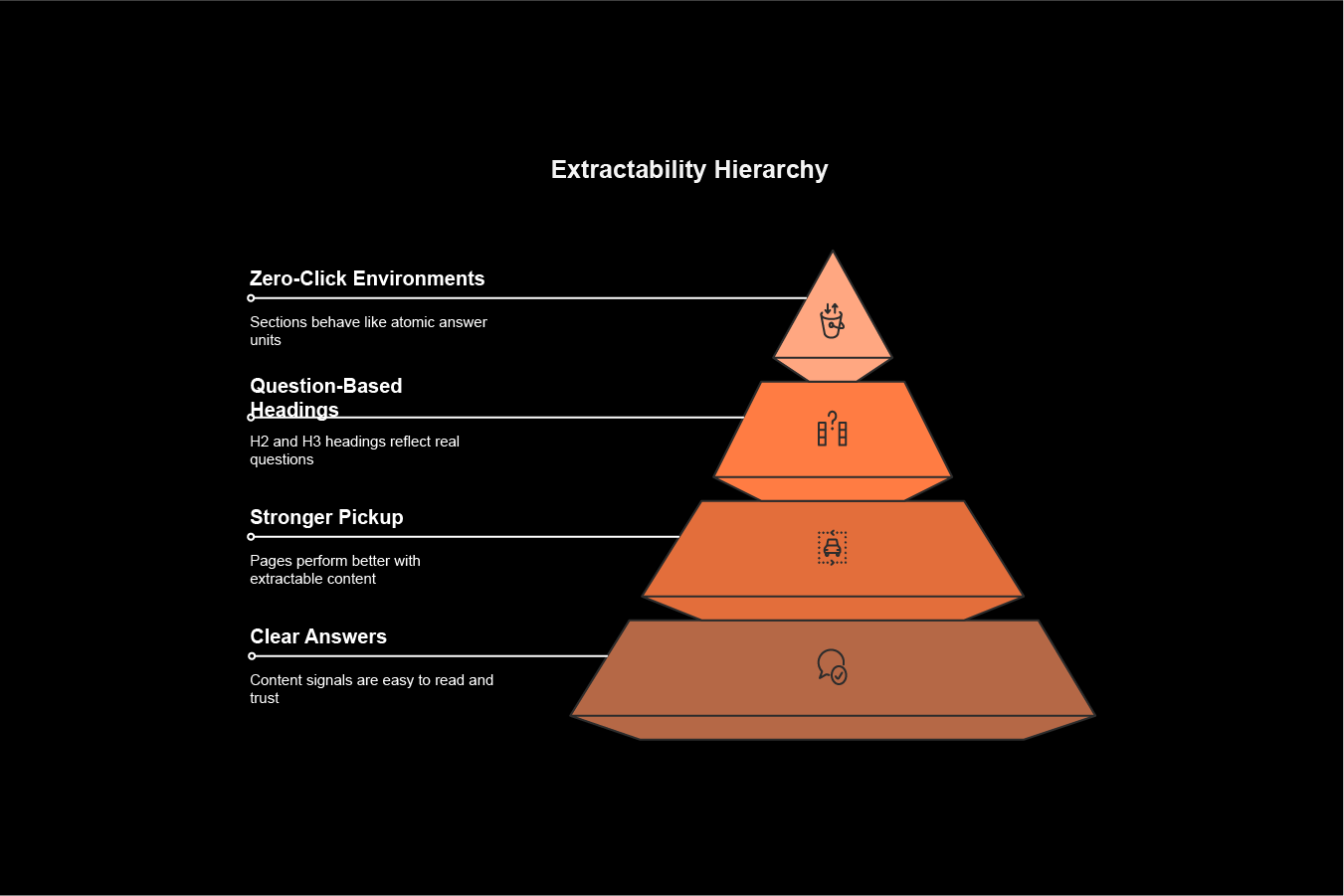
Extractability Hierarchy
Clear Answers - Content signals are easy to read and trust
Stronger Pickup - Pages perform better with extractable content
Question-Based Headings - H2 and H3 headings reflect real questions
Zero-Click Environments - Sections behave like atomic answer units
Headings should reflect real questions.
Question-based H2 and H3 headings improve passage clarity. They also help each section behave like an atomic answer unit, which is increasingly important in zero-click and citation-led environments.
Publish once. Repurpose with discipline.
The page becomes the operational centre of the content cycle.
A strong source page should not end at publication. It should feed every adjacent channel with reusable, traceable outputs.
Short-form outputs become easier to produce.
The lead answer can become a voice snippet or caption. A section opener can become a social post. Bullet summaries can become slide content. A single H2 can become a short video script or carousel concept.
Consistency compounds recognition.
Using the same phrasing, entity names, author references, and factual framing across formats helps reinforce category association over time. This is useful not only for human recognition, but also for AI systems building confidence around a brand and topic.
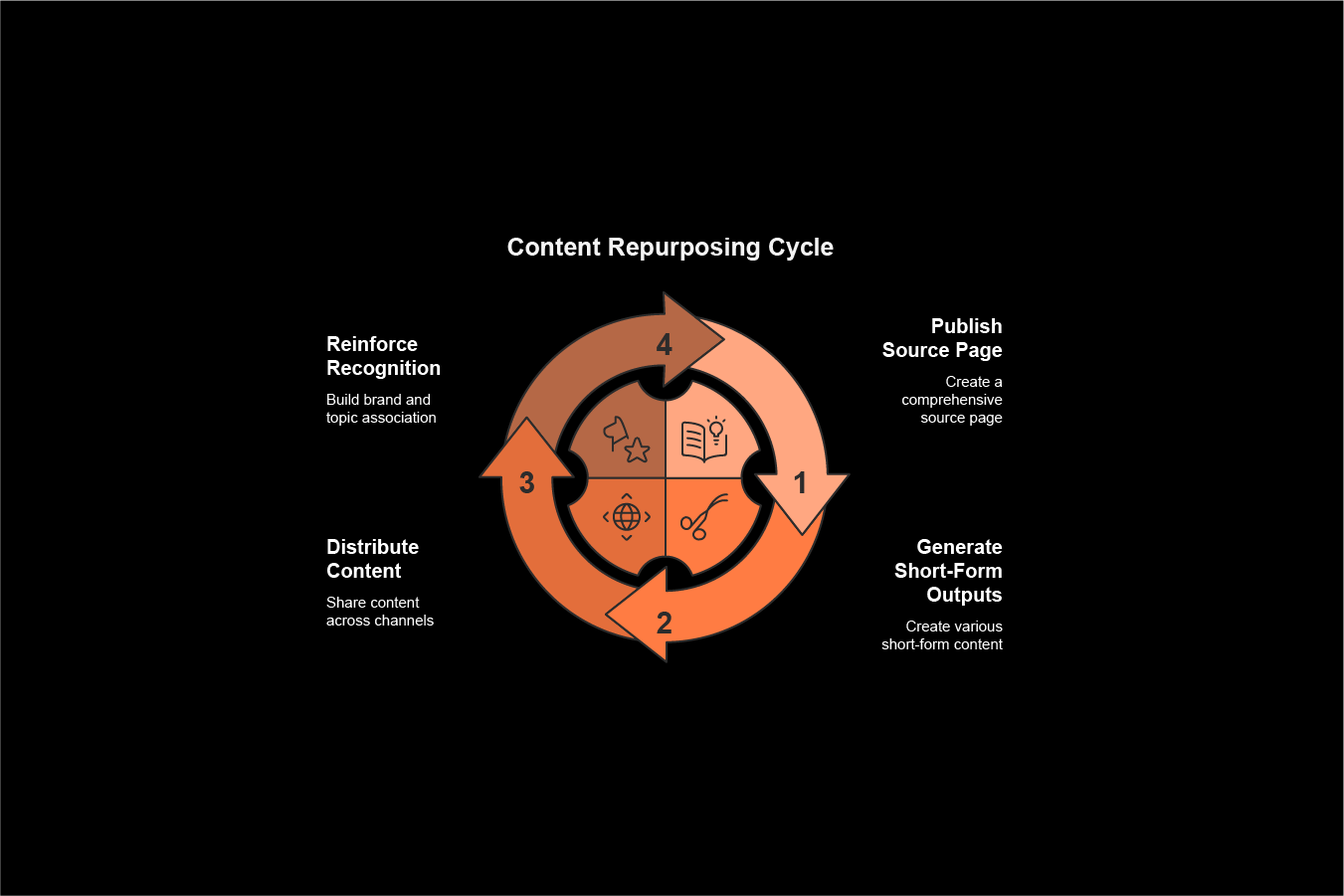
Content Repurposing Cycle
1. Publish Source Page - Create a comprehensive source page
2. Generate Short-Form Outputs - Create various short-form content
3. Distribute Content - Share content across channels
4. Reinforce Recognition - Build brand and topic association
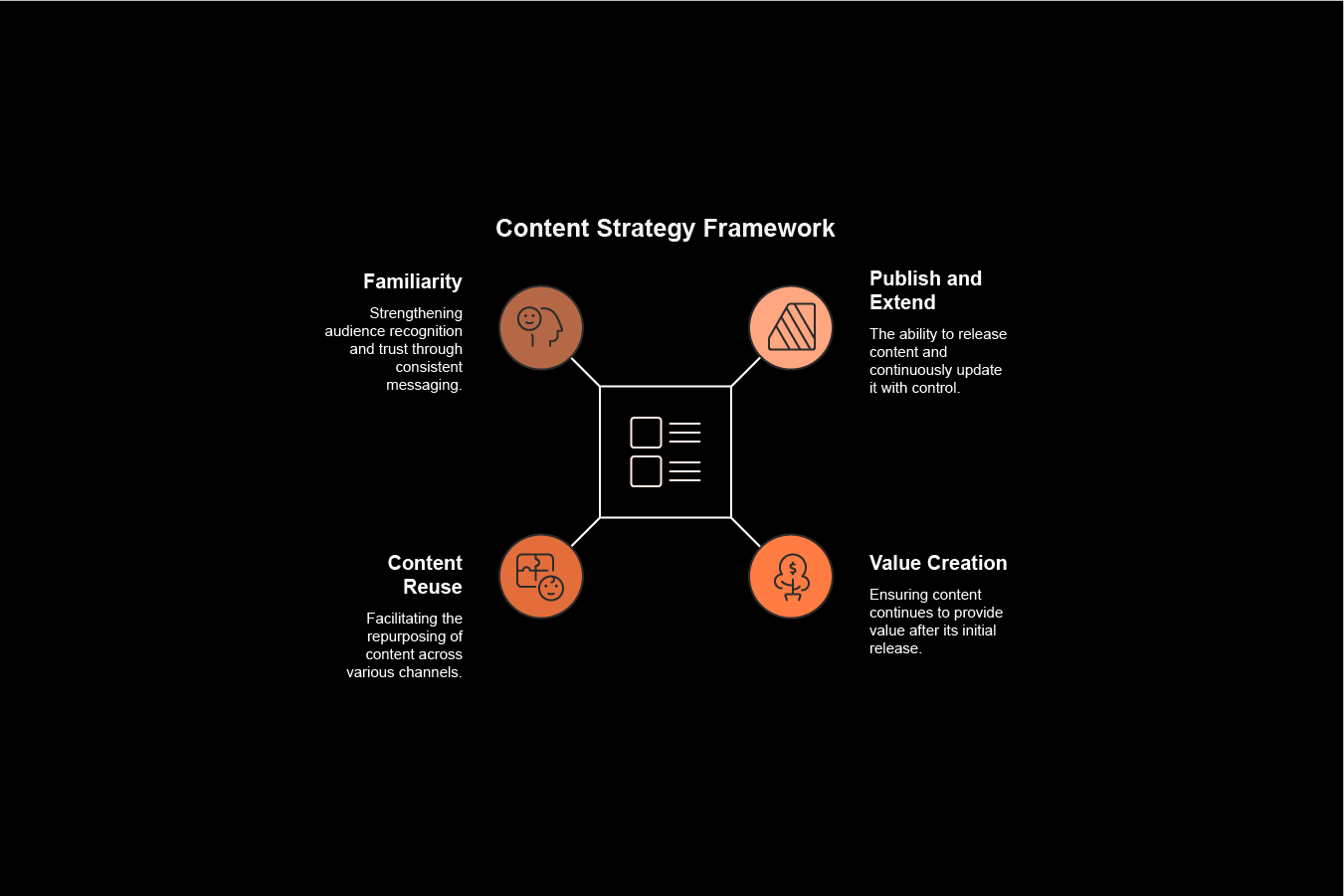
Content Strategy Framework
Familiarity - Strengthening audience recognition and trust through consistent messaging.
Publish and Extend - The ability to release content and continuously update it with control.
Content Reuse - Facilitating the repurposing of content across various channels.
Value Creation - Ensuring content continues to provide value after its initial release.
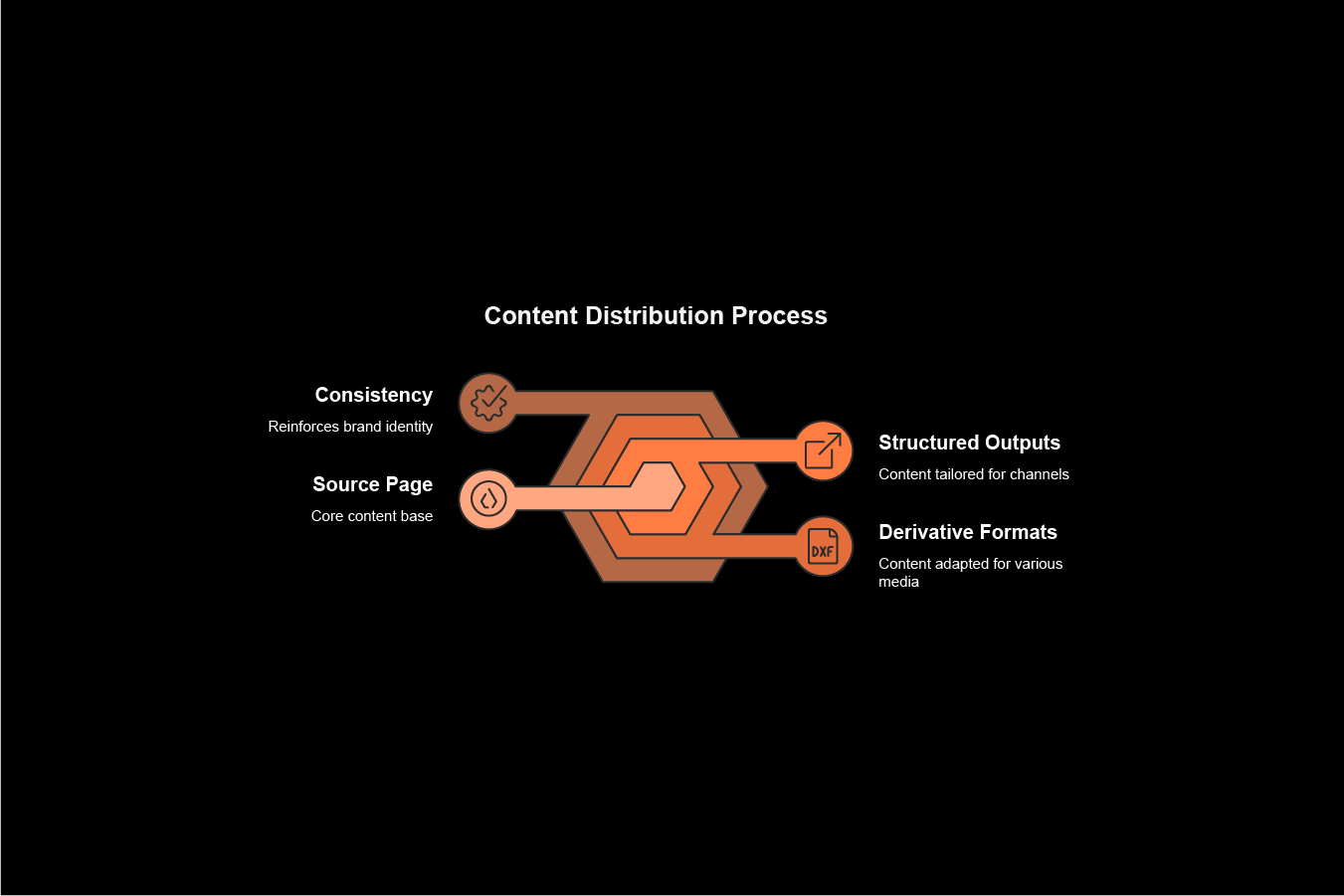
Content Distribution Process
Consistency - Reinforces brand identity
Source Page - Core content base
Structured Outputs - Content tailored for channels
Derivative Formats - Content adapted for various media
Keep the page machine-friendly.
Visibility now depends on retrieval, parsing, and trust.
The technical side of Content Domino matters just as much as the editorial side. Strong pages should be easy to access, easy to understand, and easy to validate.
Repetition is where the visibility gain starts to compound.
Content Domino works best when it becomes a routine, not a one-off exercise.
Monthly rhythm.
A practical starting cadence is one pillar page per week, or four per month, each built around a high-intent topic or commercially relevant question.
Weekly extensions.
After publishing, create supporting assets from that page over the following days or weeks: FAQs, social posts, short scripts, and refresh updates.
Ongoing refreshes.
Pages should not be left static. Rewriting a lead answer, updating examples, adjusting schema, or refreshing supporting data can improve citation pickup and answer relevance over time.
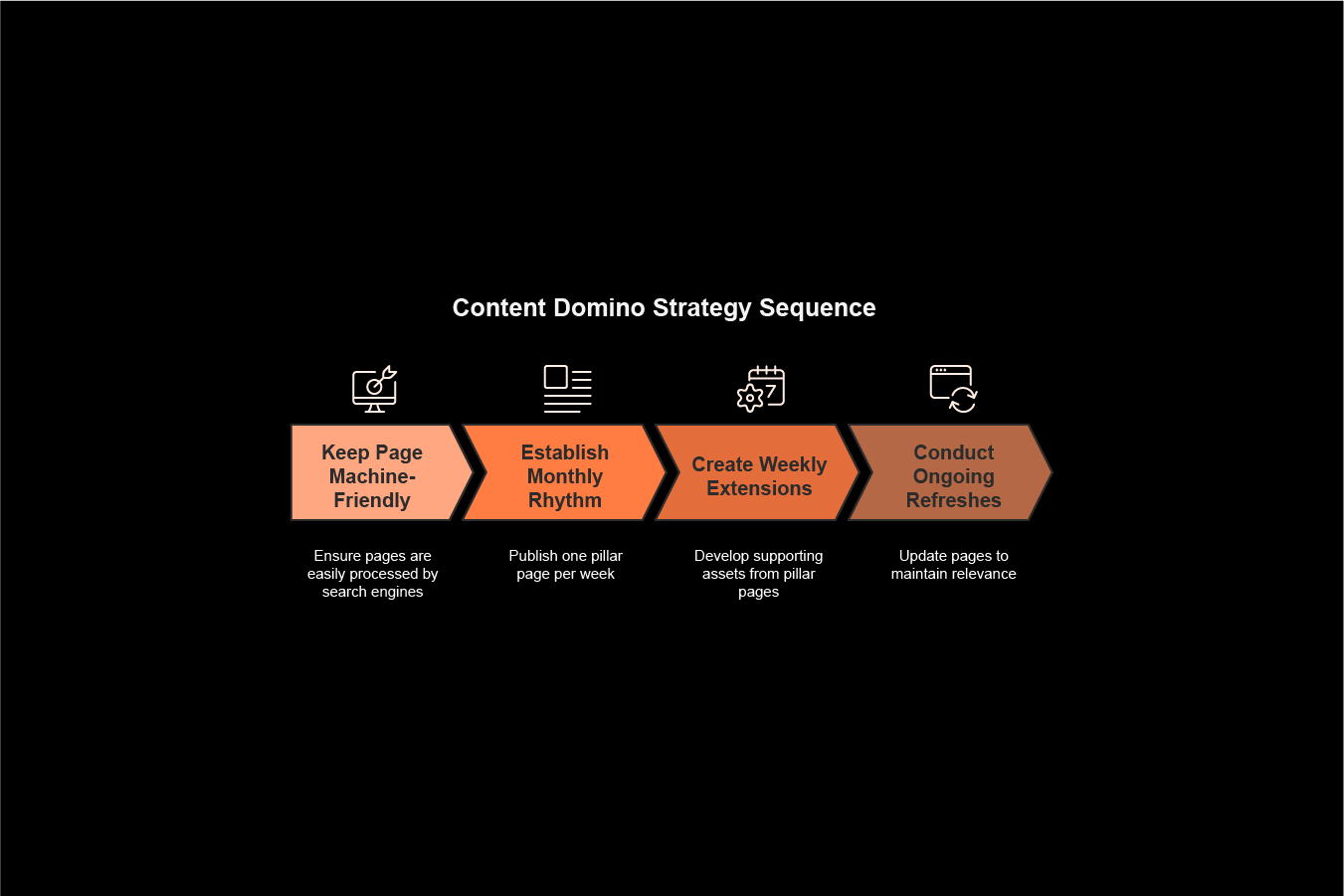
Content Domino Strategy Sequence
Keep Page Machine-Friendly - Ensure pages are easily processed by search engines
Establish Monthly Rhythm - Publish one pillar page per week
Create Weekly Extensions - Develop supporting assets from pillar pages
Conduct Ongoing Refreshes - Update pages to maintain relevance
Measure beyond clicks.
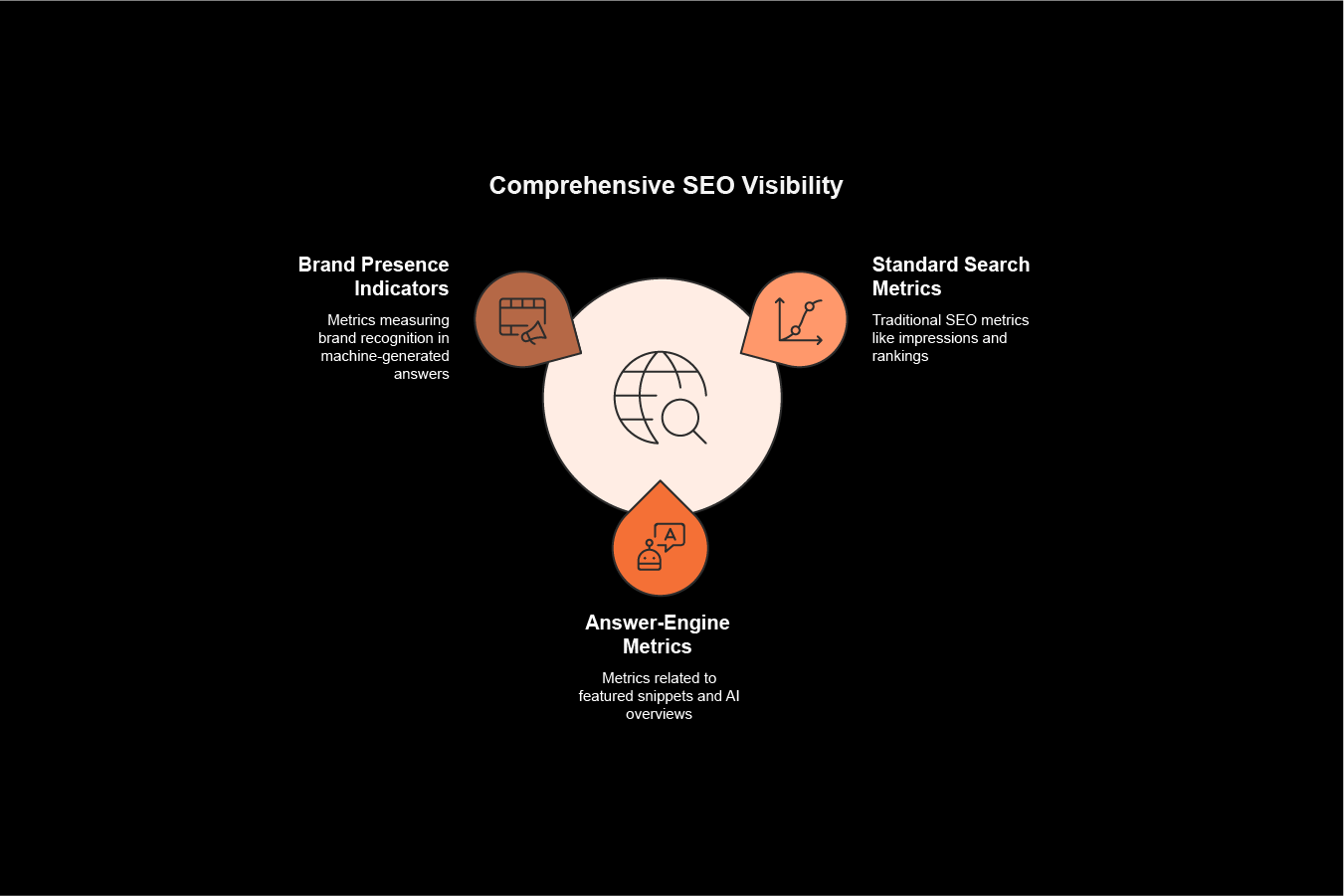
Comprehensive SEO Visibility
Brand Presence Indicators - Metrics measuring brand recognition in machine-generated answers
Standard Search Metrics - Traditional SEO metrics like impressions and rankings
Answer-Engine Metrics - Metrics related to featured snippets and AI overviews
Modern visibility requires broader signals than rankings alone.
Traditional SEO metrics still matter, but they no longer tell the whole story.
Standard search metrics.
Track impressions, rankings, organic sessions, click-through rate, and conversions.
Answer-engine metrics.
Measure featured snippet ownership, People Also Ask presence, branded citations, AI overview mentions, and referral patterns from assistant-driven visibility where available.
Brand presence indicators.
Use measures such as citation velocity, share of voice, or Share of Model proxies to understand whether your brand is becoming a recognised source inside machine-generated answers.
A minimal implementation framework.
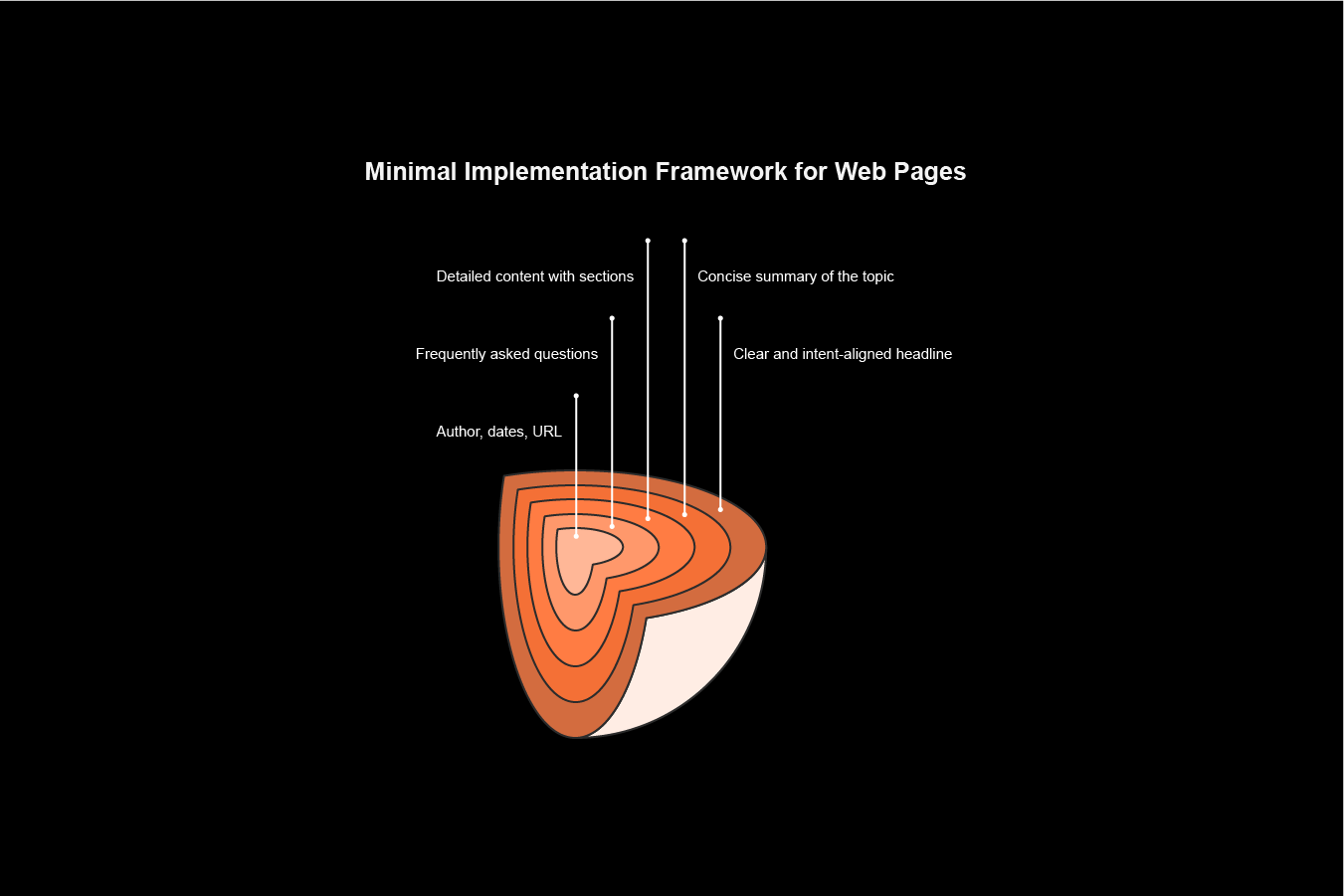
Minimal Implementation Framework for Web Pages
Author, dates, URL
Frequently asked questions
Detailed content with sections
Concise summary of the topic
Clear and intent-aligned headline
Keep the process simple enough to repeat.
Below is the practical structure that can be used as a lightweight publishing standard for each core page.
Recommended page pattern:
Title - A clear, intent-aligned page title based on the user need or topic.
Lead answer - A concise 40 to 60 word answer positioned near the top.
Structured body - A 300 to 1,000 word body broken into question-led sections with short paragraphs, supporting facts, and examples.
FAQ block - A compact FAQ section marked up with FAQPage schema where relevant.
Metadata layer - Author, publish date, update date, canonical URL, and any relevant entity information.
This pattern helps keep editorial work, technical markup, and repurposing outputs aligned from the start.
Why this works now.
Search, AI, and social increasingly reward the same core discipline.
In 2026, visibility is less about ranking one page for one keyword and more about becoming the most usable source for a topic. That means being easy to retrieve, easy to cite, and easy to trust.
Content Domino supports that shift by keeping the page central. It combines SEO fundamentals, answer-first structuring, schema clarity, repurposing discipline, and measurable iteration into one repeatable workflow.
The result is not just more content. It is a more durable system for search visibility, AI citation potential, and cross-channel brand presence.
-
Content Domino is a source-first content workflow where one authoritative page becomes the base for SEO performance, AI answer visibility, and repurposed assets across other channels.
-
A useful range is around 40 to 60 words. That is typically short enough for extractive systems and long enough to communicate a meaningful answer clearly.
-
FAQPage, HowTo, Article, BlogPosting, Product, and Speakable can all be useful depending on the page purpose. The right choice depends on the actual structure and intent of the content.
-
Search engines and AI systems need direct access to the content. Important facts hidden in images, PDFs, or inaccessible front-end layers are harder to parse, retrieve, and cite reliably.
-
That depends on the topic, but a regular update cadence helps. High-value pages benefit from refresh reviews every few weeks or months, especially when answers, examples, or schema can be improved.
-
Start with rankings, impressions, conversions, featured snippets, and AI citation presence. From there, expand into broader visibility indicators such as share of voice or citation velocity.
“Strong visibility now comes from being usable as a source, not just present as a result”
Content Domino reframes content production as a connected system. The page becomes the foundation, the answer becomes the entry point, and each downstream asset reinforces the same source rather than competing with it. That makes the workflow more efficient, but more importantly, it makes the visibility more resilient.
Read each of these dedicated articles for greater insight:




Long read